
AI Search 2026 is probably why Google has started feeling a little different lately, even if you couldn’t quite put your finger on why. If you’ve used Google Search recently, you’ve likely noticed it. Search isn’t always a simple list of blue links anymore. Sometimes Google answers your question before you even click on anything. Other times, you can keep asking follow-up questions, upload a photo, or type in a much more complicated question than you’d normally bother typing into a search box.
That shift is really at the heart of it all.
For bloggers, publishers, businesses, and everyday users, this change actually matters. Google is bringing increasingly powerful AI directly into Search, while still — for now, at least — connecting people to websites and original sources across the web. In May 2026, Google said AI Overviews had crossed 2.5 billion monthly active users, while AI Mode had passed the one-billion-user mark of its own.
At AI Tech Pulse, I’ve been tracking the rapid evolution of AI all through 2026, and Google Search might genuinely be one of the biggest changes we’ve seen yet. The real question isn’t whether Google is using AI — it clearly is, and has been for a while now.
The bigger question is: what does AI Search 2026 actually mean for how we search, how we publish content, and how we get traffic from Google going forward?
In this article, we’ll walk through seven major ways Google Search is changing because of AI, and what those changes could mean if you run a website.
What Is AI Search 2026, Really?
The phrase AI Search 2026 basically describes the growing use of generative AI, more advanced reasoning, multimodal understanding, and genuinely conversational interactions inside search engines.
Traditional Google Search was mostly built around a simple process:
Question → Search results → Website → Answer
AI-powered Search is shifting toward something that looks more like:
Question → AI understands intent → Searches multiple sources → Generates an answer → Shows supporting links → Follow-up conversation
That doesn’t mean websites have disappeared, though. Quite the opposite, actually.
Google keeps emphasizing links and connections to the wider web. In its 2026 Search updates, Google has repeatedly framed its AI features as a way to help people explore websites, original content, and useful sources more easily — not as a replacement for them.
The biggest difference is that Google is simply getting better at understanding what a user actually wants, instead of just matching a handful of words typed into a search box.
A Simple Example
Imagine someone searches:
“What is the best laptop for video editing under $1,000 for a beginner?”
A traditional search might hand back product pages, reviews, forums, and comparison articles, leaving you to piece it together yourself.
An AI-powered search experience, on the other hand, can pick up on several requirements hiding inside that one sentence:
- The laptop needs to cost less than $1,000
- It needs to actually handle video editing
- The buyer is a beginner, not a pro
- They probably want a recommendation, not a dictionary definition
- Different products will likely need to be compared
AI can then organize information around all of those requirements at once and offer a more direct answer, while still linking out to places where the user can dig deeper.
That’s really one of the core ideas behind AI Search 2026: Google is increasingly trying to understand the intent sitting behind a question, not just the literal words inside it.
1. AI Overviews Are Changing the First Screen of Google
One of the most visible changes so far is AI Overviews.
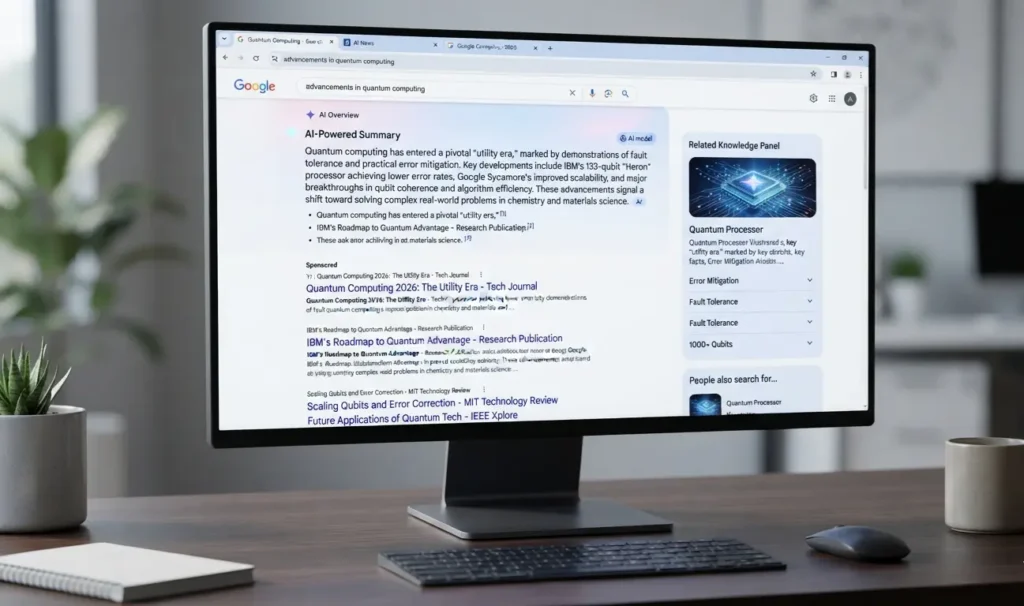
Instead of jumping straight to a traditional list of search results, Google can now display an AI-generated summary near the top of the page whenever it decides the feature would actually be useful.
This changes the very first interaction between a user and Google.
Before AI Overviews became a major part of Search, a user might have seen, in order: search ads, a featured snippet, organic results, related questions, and a handful of other search features.
Now, depending on what you’ve typed, you might see an AI-generated explanation first, complete with links out to the websites backing it up.
Google upgraded AI Overviews with Gemini 3 back in January 2026, and added the ability to jump straight from an AI Overview into a full conversational back-and-forth through AI Mode.
That’s a genuinely big change, because the search result page is no longer necessarily the final destination. The AI response can now be the starting point of a much longer search journey rather than the end of one.
Why This Matters for Websites
This creates both an opportunity and a challenge at the same time.
A website can potentially become one of the sources Google leans on when putting together an AI response. But a user might also get enough out of the AI Overview itself that they never click through to every website listed further down the page.
That means website owners need to start thinking beyond the old question of “how do I rank number one?”
The better question, increasingly, is: “how can my content be useful enough to get discovered, cited, referenced, or selected within AI-powered Search?”
That’s an important mindset shift heading further into AI Search 2026.
2. AI Mode Is Turning Search Into a Conversation
AI Overviews are only part of the story, though. Google’s AI Mode goes a lot further than that.
Instead of treating every search as a completely separate question, AI Mode lets users continue a conversation and ask follow-up questions while Google keeps hold of the context from your previous exchange. Google actually described this as a more seamless transition between an AI Overview and AI Mode in its January 2026 update.
For example, imagine you search:
“Plan a three-day trip to London for a first-time visitor.”
The first response might hand you an itinerary. But instead of opening a brand-new search, you could just keep going:
“Make it cheaper.”
Then:
“Add some museums.”
Then:
“Which area should I actually stay in?”
Then:
“Can you make the final itinerary family-friendly?”
The whole search experience turns into a conversation, back and forth, rather than a one-shot query. That’s fundamentally different from the old keyword-based model most of us grew up with.
Search Is Becoming More Natural
People don’t always think in perfect keywords. They think in questions. They change their minds halfway through. They add requirements as they go. They ask follow-ups. They compare options out loud. They correct themselves mid-thought.
AI happens to be particularly good at handling exactly this kind of conversational back-and-forth.
Google’s own 2026 research into AI Mode notes that people are searching differently now — asking questions that are more complex and closer to what’s actually on their mind, rather than stripped-down keyword phrases.
This is one of the clearest signs that AI Search 2026 isn’t simply about bolting an AI box onto Google. It’s about changing the underlying behavior of Search itself.
🎥 WATCH: Google AI Mode
Video: Meet AI Mode – Try a whole new way to search — official Google video.
3. Google Is Learning to Handle Longer and More Complex Questions
Another major change is the type of questions Google can handle.
Traditional search worked extremely well for short queries such as:
“weather London”
“iPhone 18 price”
“best restaurants near me”
But modern AI Search can handle questions with multiple conditions.
For example:
“I’m starting a small online business with $500. I need free AI tools for writing, images, customer support and social media. Which tools should I use, and what would my workflow look like?”
That is not one simple question.
It contains several connected tasks.
Google’s AI Mode uses a technique known as query fan-out, where the system can break a complicated question into related searches across different subtopics and sources, then combine the information into a response.
This is important because the search engine is effectively doing some of the research work before presenting the answer.
What query fan-out means
A simplified example might look like this:
How AI Search Investigates the “Best Laptop for Editing”
An analytical look into how search engines evaluate creative workstations.
Analyzes single-core speeds for smooth timeline scrubbing and multi-core processing for heavy export tasks.
Evaluates dedicated VRAM, architecture, and hardware acceleration required for real-time effects and 3D rendering.
Benchmarks system memory pools, identifying 16GB as baseline and 32GB-64GB for multi-layer 4K/8K timelines.
Cross-references optimizations for major creative tools like Adobe Premiere Pro, DaVinci Resolve, and Final Cut Pro.
Filters cost-to-performance metrics while tracking expert feedback on thermal performance and display accuracy.
Compares mobile workflows against custom desktop PCs to give creators a comprehensive architectural alternative.
The user may only type one question, but the system can investigate several connected topics behind the scenes.
That makes search more useful for complicated decisions.
It also creates a new challenge for publishers.
A single article may no longer compete only for one keyword.
It may need to answer several related questions clearly enough to become useful within a broader search journey.
4. Search Is Becoming Multimodal
Text is no longer the only way people search.
AI Search 2026 is increasingly multimodal.
That means users can interact with Search using combinations of:
- Text
- Images
- Voice
- Files
- Videos
- Visual information
Google’s May 2026 Search announcements described a redesigned AI-powered Search box that can accept text, images, files, videos, and even Chrome tabs as inputs in supported AI Mode experiences.
That opens up completely different ways of searching.
Imagine this scenario
You see a strange plant while walking outside.
Instead of typing:
“Plant with long green leaves and small purple flowers”
You can take a picture.
Google can analyze the image and help identify it.
Or imagine you have a PDF containing a complicated chart.
Instead of manually describing the chart, you can provide the file and ask:
“Explain this in simple language.”
The search engine is no longer limited to understanding words.
It can understand different types of information together.
Why multimodal Search matters for content creators
This creates another opportunity for publishers.
Images, diagrams, screenshots, videos, charts, and other visual assets can become part of how users discover information.
That does not mean simply adding random images to an article will automatically bring traffic.
The visuals still need to be useful.
A good chart can explain something faster than 500 words.
A screenshot can show a process.
A diagram can simplify a technical concept.
A short video can demonstrate something that text cannot explain easily.
This is why the future of SEO is increasingly connected to content quality across multiple formats, not just written paragraphs.
5. Google Is Trying to Connect AI Answers Back to the Web
There’s a common fear floating around AI Search these days: “If Google just gives people the answer directly, won’t websites become useless?”
The reality is a bit more complicated than that.
Google keeps emphasizing links and original content within its AI experiences. In May 2026, Google announced new ways to help people discover relevant websites, original content, and firsthand perspectives through both AI Overviews and AI Mode.
Google also introduced something called Preferred Sources inside AI Search, letting users see more content from websites they specifically choose to follow. Google said people were twice as likely to click through to a Preferred Source compared to other results.
That’s actually an important signal for publishers to pay attention to. The web isn’t disappearing from AI Search — the relationship between the AI answer and the website underneath it is just changing shape.
The old model: Search → Click → Read
The newer model: Search → AI summary → Explore sources → Click → Read deeper
That difference matters a lot more than it might seem at first glance. A person might use AI to get the basic answer sorted out, and then still visit a website because they want more detail, evidence, original reporting, a proper tutorial, product comparisons, firsthand experience, expert analysis, real examples, or simply more up-to-date information.
For a website like AI Tech Pulse, this means just publishing generic AI-style summaries isn’t going to cut it anymore. The content genuinely needs to offer something worth the click.
So What Does This Mean for Bloggers?
If you’re a blogger watching all of this unfold and wondering, “is SEO finished?” — the short answer is no. But it is evolving, and pretending otherwise won’t help anyone.
Google’s own 2026 guidance still emphasizes the same fundamentals it always has: making genuinely useful content accessible to Search. Its AI Search updates are simply creating additional ways for websites and creators to show up within these AI-powered experiences.
The goal shouldn’t be to write specifically for a machine. The goal should be to create content that’s helpful, original, easy to actually understand, well structured, trustworthy, kept up to date, backed by useful sources, and written for real people first.
AI might change how people stumble onto your article in the first place. But good content still has to give them a reason to trust it, and to actually visit your website once they’ve found it.
AI Search 2026: The First Big Shift
We have already seen several major changes:
The Evolution of AI Search Features
How advanced intelligence models are reshaping the way we find information online.
Search engines now distill complex web data directly at the top of the viewport, presenting instantaneous structural answers to high-intent queries before standard indexing links appear.
Moving beyond static queries, the platform enables contextual multi-turn dialogue, remembering user intent history and refining output synthesis dynamically based on subsequent replies.
Parallel processing models break down compound multi-layered questions, triggering synchronized sub-searches across diverse hardware, software, and value matrices simultaneously.
Breaks down standard text limitations by allowing direct sensory ingestion. Users can upload high-resolution graphics, datasets, or code repositories to parse exact contextual relationships.
Maintains strong foundational grounding and reference pipelines by explicitly linking critical metrics, review logs, and primary source citations back to authoritative underlying creators.
6. Original and Firsthand Content Is Becoming More Important
AI can generate an explanation about almost anything in seconds.
That sounds impressive, but it creates a serious problem.
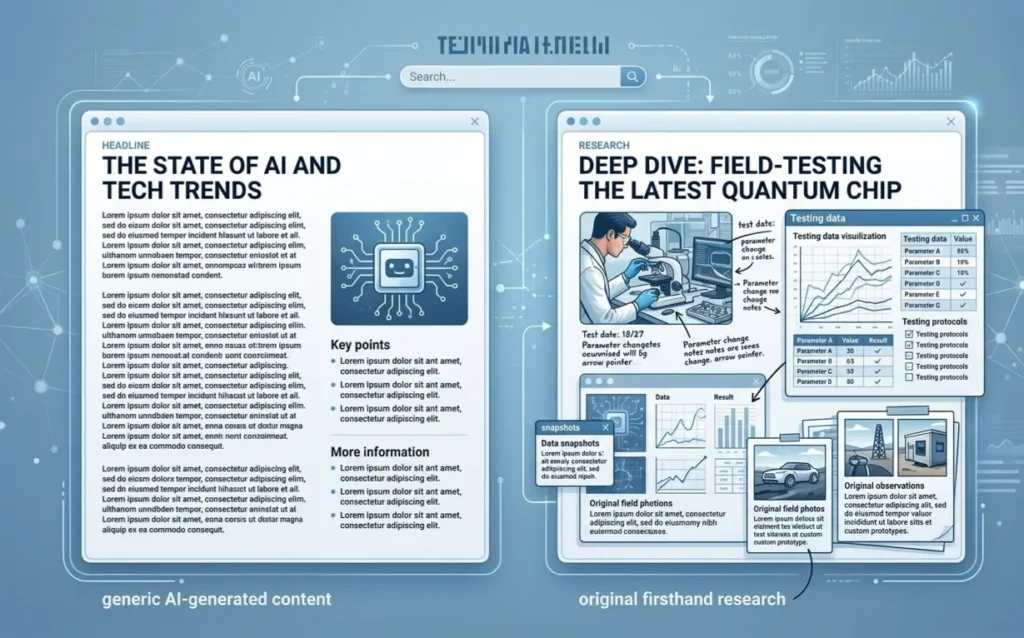
If hundreds of websites publish essentially the same AI-generated explanation, what makes one page more valuable than another?
This is where original content becomes important.
Google has repeatedly emphasized helpful, reliable content and original perspectives. In 2026, Google also expanded ways for people to discover original content and firsthand perspectives through AI Overviews and AI Mode.
Think about two articles.
Article A
“Here are 10 AI tools you should try in 2026.”
It contains general descriptions that could have been generated by almost any website.
Article B
“I tested these 10 AI tools for two weeks. Here is what worked, what failed, how much each cost, and which one I would actually use.”
The second article provides something much harder to replicate.
It contains experience.
That distinction could become increasingly important in AI Search 2026.
What Does Firsthand Content Look Like?
Firsthand content does not necessarily mean you need to be a famous expert.
It can be simple.
For example:
- Testing a software tool yourself
- Showing screenshots from your own workflow
- Comparing two products after using them
- Explaining a problem you personally solved
- Recording actual performance results
- Sharing a genuine case study
- Showing step-by-step results
- Explaining what did not work
These details make content more useful.
Imagine an article about an AI writing tool.
A generic article might say:
“This tool is fast and easy to use.”
A stronger article might say:
“I used the tool to rewrite five product descriptions. The first two needed almost no editing, while the longer descriptions required several changes to tone and factual details.”
The second example gives the reader something practical.
Why Generic Content Faces a Bigger Challenge
There was already a lot of repetitive content on the internet before generative AI became popular.
AI has made it much easier to create even more.
That means the internet can quickly become filled with articles that say the same thing in slightly different words.
Google’s systems are designed to prioritize helpful content rather than simply rewarding pages because they contain a particular keyword. Google’s guidance for AI features also continues to point website owners toward established Search fundamentals rather than special tricks designed only for AI features.
This is good news for serious publishers.
You do not necessarily need to publish 10 articles every day.
A better strategy can be:
Research → Test → Explain → Add evidence → Update
rather than:
Generate → Publish → Repeat
That difference may become increasingly important as AI Search becomes more sophisticated.
7. SEO Is Not Dead — But the Definition of Visibility Is Changing
Every time Google introduces a major Search change, the same question appears:
“Is SEO dead?”
We heard it when featured snippets became popular.
We heard it when voice search became popular.
We heard it when mobile-first indexing arrived.
And now we are hearing it because of AI.
The reality is more nuanced.
SEO is not disappearing.
Search visibility is expanding.
Traditional SEO still matters because Google needs to discover, understand, index, and rank web content.
But AI Search adds another layer.
A page can potentially be:
- A traditional organic result
- A supporting source in an AI Overview
- A link surfaced through AI Mode
- A source discovered through a conversational search
- A page recommended after a follow-up question
This means website owners need to think about visibility across the entire search journey.
Traditional SEO vs AI Search
The Evolution: Traditional vs AI Search 2026
A direct architectural comparison showing how modern search experiences are transforming.
This does not mean you should throw away your existing SEO strategy.
It means you should build on it.
Technical SEO, internal linking, clear headings, useful content, descriptive titles, crawlability, page experience, and strong topical coverage can still provide the foundation.
AI features are being built on top of Search, not in a completely separate universe.
The New Question: Can AI Discover Your Content?
This is where things become interesting.
In traditional Search, a website owner might think:
“I need Google to rank my page.”
In an AI-powered Search environment, another question appears:
“Can Google’s AI systems understand what my page is about and identify it as a useful source?”
That requires clear content.
If your article is confusing, poorly structured, full of vague claims, or missing important context, it becomes harder for both humans and machines to understand.
Good structure therefore matters.
For example, instead of writing one huge block of text about AI Search, you can organize it into:
- What AI Search is
- How AI Overviews work
- What AI Mode changes
- How search behavior is evolving
- What it means for publishers
- How to adapt
- Common questions
This helps readers scan the article.
It also makes the subject matter easier to understand.
Google Is Giving Website Owners More Data
There is another major development that bloggers should pay attention to.
Google has started adding reporting around visibility from generative AI features.
In June 2026, Google announced a new Search Console report that includes traffic from generative AI features such as AI Overviews and AI Mode within Search performance reporting.
This is important because website owners have historically relied heavily on:
- Clicks
- Impressions
- Average position
- CTR
AI Search creates a slightly different problem.
A website may appear as a supporting source in an AI-generated response even though the user does not interact with it in exactly the same way they would with a traditional result.
Better reporting can help publishers understand how AI-powered Search is contributing to overall visibility.
For bloggers, this means Search Console becomes even more important.
🎥 WATCH: Google Search Console and AI Search
AI Search 2026 Could Change What a “Click” Actually Means
For years, website traffic was fairly easy to understand. Someone searched for something. They saw your result. They clicked. They landed on your page. Simple enough.
But AI-powered Search can create a very different kind of journey. A user might ask a question and get an AI-generated summary back. They might read through it. Then they might ask a follow-up question. Only later might they click through to a source — or they might click immediately because they wanted deeper information from the start. There’s no single fixed pattern anymore.
This means publishers shouldn’t judge their entire strategy off one single number. Traffic still matters, of course. But the fuller picture now includes things like search impressions, overall search visibility, click-through rate, returning visitors, brand searches, direct traffic, engagement, content citations or references, and your overall topical authority in a space. The search journey itself is simply becoming less linear than it used to be.
Why Brand Recognition May Matter More Now
Here’s an interesting side effect of AI Search. When AI hands users several sources at once, people start remembering the names of websites that consistently show up with useful information.
Imagine someone repeatedly sees names like AI Tech Pulse, Search Engine Journal, Google Search Central, TechCrunch, and The Verge pop up across different searches. Over time, those names simply become familiar — and that familiarity ends up shaping future searches.
Instead of typing “best AI news website,” a person might just search directly for “AI Tech Pulse ChatGPT update.” Brand recognition becomes another layer of SEO strategy in its own right.
This matters especially for smaller publishers. You’re not just trying to rank one individual article anymore — you’re trying to build a publication people actually recognize by name.
AI Search Rewards Clear Answers — But Depth Still Matters
There’s a temptation to assume AI Search means every article should be short and stripped down. That’s not really true.
A good article still needs to match the intent behind the question. If someone asks “what is AI Search?” they probably just need a simple, clear explanation. But if they ask “how is AI changing Google Search and what should bloggers do about it?” — they need a lot more. They likely want examples, explanations, data, comparisons, practical steps, expert sources, and real case studies.
The best content isn’t automatically the longest piece on the page. It’s the content that gives the reader enough genuinely useful information to actually accomplish whatever goal sent them searching in the first place. That’s exactly why this piece isn’t just repeating Google’s own announcements back at you — the goal is to actually explain what these changes mean for real website owners.
AI Search Is Becoming More Personal and Context-Aware
Another big shift is context. Traditional Search generally treated every query as a completely separate, isolated event. AI systems, on the other hand, can understand the relationships between one question and the next.
For example:
“What is the best camera for YouTube?” “I have a $1,000 budget.” “I record mostly indoors.” “I also need good autofocus.”
The final recommendation can weigh all of those requirements together at once. That makes Search genuinely more useful — and it also changes how content should be written in the first place.
Instead of building a separate page for every tiny variation of a keyword, publishers can build one comprehensive resource that naturally answers a whole cluster of related questions. A single strong article about beginner cameras, for instance, might cover budget, image quality, autofocus, low-light performance, audio, accessories, software, and a full beginner setup — all in one place. That gives the page much broader topical usefulness than a dozen thin, narrowly-targeted pages ever could.
Topic Coverage Can Matter More Than One Single Keyword
This might be one of the biggest lessons from AI Search 2026.
Say you’re writing about “AI agents for small businesses.” You could focus narrowly on just that exact keyword phrase. Or you could cover the whole surrounding cluster of questions: what AI agents actually are, how they work, what tasks they can automate, which businesses actually benefit, what the risks look like, what they typically cost, which tools are available, how a business should start, and how much human oversight is still needed.
The second approach builds a far more complete resource — and it also gives search systems a lot more context to work with. This doesn’t mean stuffing every loosely related keyword into one article for the sake of it. It means genuinely answering the questions that belong to that topic.
What Should Bloggers Actually Do Differently in 2026?
If you’re publishing content right now, the safest move isn’t chasing every new AI feature as it drops. It’s strengthening the fundamentals that were always going to matter.
1. Write for humans first. If an article sounds unnatural or robotic, readers notice immediately.
2. Add genuinely original information. Your own testing, screenshots, examples, research, or analysis make content far more useful than a rehash of what’s already out there.
3. Make facts easy to verify. Lean on trustworthy external sources whenever you’re discussing technical or fast-changing information.
4. Organize content clearly. Use descriptive headings, short paragraphs, lists, and tables wherever they genuinely help the reader.
5. Keep important information updated. AI Search changes fast — an article that was accurate in January 2026 may well need a refresh later in the same year.
6. Build a recognizable brand. Don’t treat every article as an isolated, standalone page. Build a publication that readers actually remember and come back to.
A Practical AI Search 2026 Strategy
Content Excellence Strategy for 2026
A precise operational guide to ranking, building trust, and driving long-term value in the age of AI search engines.
Get discovered
Technical SEO + clear topical relevance
Optimize indexability pipelines, structured schema trees, and semantic data models to guarantee discovery during automated matrix indexing sweeps.
Get understood
Strong structure and precise explanations
Deploy highly structured, unambiguous logical flows and hierarchical heading frameworks to maximize data evaluation clarity for LLM entity parsers.
Become useful
Original research and practical examples
Produce unparalleled secondhand data assets, custom workflows, code repositories, and real-world testing telemetry that cannot be easily replicated by AI synthesis tools.
Build trust
Reliable sources and transparent claims
Ground all analytical perspectives in clear peer verification frameworks, verifiable hardware benchmark records, and highly explicit citation graphs.
Earn clicks
Give readers a reason to explore deeper
Inject immersive visual assets, cross-linked multi-step tools, and interactive configurations that prompt users to jump beyond AI snapshots.
Build long-term traffic
Brand + useful content library
Construct an evergreen ecosystem around community loyalty, establishing a resilient tech authority footprint that attracts consistent returning direct search entry flows.
The important thing is balance.
Do not abandon SEO because AI exists.
Do not ignore AI because traditional Search still exists.
Build for both.
A Simple Example for AI Tech Pulse
Imagine I publish an article called:
A weak version might contain:
- Seven tool names
- One paragraph about each
- Affiliate links
- Generic descriptions
- No testing
- No screenshots
- No comparison
A stronger version could include:
- Who each tool is best for
- Actual pricing
- Strengths and weaknesses
- Writing samples
- Personal testing
- Comparison table
- Screenshots
- External references
- Frequently asked questions
- Updated information
The second article gives readers considerably more value.
And that is the direction publishers should be thinking about as AI Search 2026 develops.
The Bigger Picture
Google Search is not simply adding artificial intelligence to an existing product.
It is gradually changing the relationship between:
Users → Questions → Search → AI → Websites
The user can ask more complex questions.
Google can investigate multiple angles.
AI can summarize information.
The user can continue the conversation.
And websites can still provide the deeper information behind that journey.
That creates a more complicated ecosystem than traditional Search.
But it also creates opportunities.
Small publishers that produce genuinely useful, original, well-structured content can still compete.
The key is understanding what AI cannot replace easily.
Experience.
Original research.
Trust.
Useful analysis.
A recognizable voice.
And most importantly, a reason for the reader to go beyond the AI-generated summary.
What Comes Next?
So far, we have covered six major changes shaping AI Search 2026:
- AI Overviews are changing the first screen of Search.
- AI Mode is turning Search into a conversation.
- Google can handle more complex questions.
- Search is becoming increasingly multimodal.
- AI experiences continue connecting users with web sources.
- Original and firsthand content is becoming increasingly valuable.
But there is still one major question:
What should website owners actually do about all of this?
So far, we have seen how dramatically Google Search is changing.
AI Overviews can answer questions directly. AI Mode can turn a search into a conversation. Google can break complicated questions into multiple searches, understand images and other inputs, and connect AI-generated answers with information from websites across the web.
But there is one question left:
What should website owners actually do about AI Search 2026?
The good news is that you do not need to completely rebuild your SEO strategy.
Google’s own guidance for AI features continues to point website owners toward many of the same fundamentals that have always mattered: crawlable pages, useful content, clear structure, strong page experience, and information that genuinely helps users.
The difference is that those fundamentals now need to work inside a much more complicated search environment.
7. SEO Is Becoming About Visibility, Not Just Rankings
For a long time, SEO was often explained with one simple goal:
Get to position #1 on Google.
That goal still matters.
But AI Search 2026 is making the search journey more complicated.
A website can potentially be discovered through:
- Traditional organic results
- AI Overviews
- AI Mode
- Follow-up questions
- Related searches
- Images
- Videos
- Brand searches
- Links included in AI-generated responses
This means your SEO strategy should not depend on a single ranking position.
Instead, think about search visibility as a whole.
A page that ranks at position three may still be valuable.
A page that appears as a supporting source in an AI experience may receive a different kind of exposure.
And a website that repeatedly appears across related searches can gradually build brand recognition.
That is why the future of SEO is less about one isolated ranking and more about being visible wherever your audience is looking for information.
How to Prepare Your Website for AI Search 2026
You don’t need some expensive AI platform to get your website ready for any of this. In fact, a lot of the most useful improvements are surprisingly simple.
1. Make Your Content Easy to Understand
Start with the basics. Use a clear headline. Break big sections up into descriptive H2 and H3 headings. Keep your paragraphs reasonably short. Explain technical terms instead of assuming every single reader already knows them. Use tables when they genuinely make comparisons easier to follow, and bullet points when readers need to scan information quickly rather than read every word.
This helps human readers first and foremost. But when content is clearly organized like this, it also becomes much easier for search systems to understand how different sections of your page relate to each other.
2. Answer the Main Question Early
One common mistake in online articles is taking way too long to actually get to the point. If someone searches “what is AI Mode?” they shouldn’t have to wade through 800 words before finding out what AI Mode actually is.
Give the basic answer early, then build out from there with context, examples, details, evidence, comparisons, and practical advice.
For example: AI Mode is Google’s conversational Search experience that lets users ask complex questions, explore a topic through follow-up questions, and get AI-generated responses with links to supporting information. Then explain how it actually works.
This kind of structure works well for both readers and search systems alike.
3. Stop Writing Only for Keywords
Keywords still matter, sure. But writing an article by repeating the exact same phrase over and over isn’t a strong SEO strategy anymore.
For example, if your focus keyword is “AI Search 2026,” you don’t need to write something like: “AI Search 2026 is changing Search. AI Search 2026 is important. AI Search 2026 will change SEO.” That reads unnaturally, and readers can tell.
Instead, use the keyword naturally while actually covering the topic in depth. You can bring in related concepts like Google AI Search, AI Overviews, AI Mode, conversational Search, generative Search, AI-powered results, search visibility, and AI SEO. These related ideas help build a complete article without forcing the same exact phrase into every single paragraph.
4. Build Topic Clusters Instead of Isolated Articles
Another smart move for publishers is creating genuinely connected content. Say your website has one article about AI Search 2026 — you could support it with related pieces like “Google AI Overviews explained,” “What is Google AI Mode?”, “AI SEO strategies for bloggers,” “AI agents and search,” “How AI is changing content creation,” “Google Search Console for beginners,” and “How to write helpful AI-related content.”
Then link those articles together internally. This builds a network of related information, so a reader can move from one piece to the next without ever leaving your website — and it also helps search engines understand exactly what your site covers as a whole.
5. Add Original Evidence Whenever You Can
This might end up being one of the strongest advantages human publishers still have. AI can summarize existing information very quickly, but it can’t fake your own genuine, firsthand experience.
Say you’re reviewing an AI tool. Instead of just writing “the tool is easy to use,” show the reader how you actually tested it, what task you gave it, what result you got back, how long it took, what went wrong along the way, what you had to change, and whether you’d actually use it again. That’s what turns a generic review into a real, useful resource.
The same idea applies to tutorials. If you’re explaining how to use a tool, real screenshots from the actual process are often more useful than another thousand words describing the interface in prose.
6. Keep Your Content Fresh
AI Search is moving extremely fast right now. Google can roll out a new feature, change its interface, expand availability, update the underlying model, add new capabilities, or change how results are displayed — sometimes all within the same few months.
That means AI-related articles can go stale surprisingly quickly. For a website covering technology, updating older content can end up being just as important as publishing new articles in the first place.
Build yourself a simple update routine. Every few months, check whether the information is still accurate, whether the links still work, whether Google has changed the feature you’re writing about, whether your screenshots look outdated, whether prices are still correct, whether a tool has changed its name, whether there are newer official sources to reference, and whether the article still actually answers the reader’s question. An article published in January doesn’t automatically stay accurate for the rest of 2026.
7. Use Google Search Console as Your Reality Check
SEO decisions shouldn’t be based entirely on guesswork. Search Console can show you what’s actually happening with your content in the real world.
Keep an eye on impressions, clicks, CTR, average position, the specific queries bringing people in, and which pages are actually receiving traffic. Google’s 2026 Search Console updates also offer more insight into performance from its generative AI Search features, which makes the platform more useful than ever for publishers trying to track AI-driven search visibility.
This builds a genuinely useful feedback loop: publish, monitor, learn, improve, update — and then repeat, rather than just publishing and hoping for the best.
Publish → Forget
🎥 WATCH: Google Search Central
Official resource: Google Search Central
AI Search 2026 Doesn’t Mean “Write More AI Content”
This point genuinely deserves some attention.
The rise of AI Search doesn’t mean bloggers should suddenly start pumping out more AI-generated articles. In fact, doing that without adding real value could actually make a website less distinctive, not more competitive.
The internet already has millions of pages explaining the exact same basic concepts. If your article just combines information everyone else has already published, why would a reader pick yours over theirs?
Instead, ask yourself: what can this article offer that a generic AI answer simply can’t? Maybe it’s personal testing, original screenshots, clearer explanations, a genuinely unique comparison, new research, local knowledge, a real case study, a workflow that actually works, expert interviews, your own data analysis, or a clear step-by-step guide nobody else bothered to write properly.
That’s exactly where human publishing can still be powerful.
Should You Stop Using AI to Write Articles?
No, not at all.
AI can be extremely useful for research, brainstorming, outlining, editing, summarizing, and generally speeding up your workflow. The problem isn’t really the use of AI itself — the problem is publishing low-value content with no meaningful human contribution behind it.
A better workflow looks something like this: research → AI assistance → human verification → original analysis → editing → publishing → updating.
Not this: AI prompt → copy → publish.
That distinction matters more than it might seem. If you treat AI as an assistant rather than a replacement for your own judgment, you can produce content more efficiently while still holding onto a voice that actually sounds like you.
The Role of Trust Is Growing
Imagine two search results sitting side by side.
Website A: no author information, no sources, no dates, no examples, and it makes big claims without any evidence backing them up.
Website B: clearly explains who wrote it, when it was last updated, where the important facts came from, what was actually tested, which parts are opinion, and which parts are confirmed fact.
Which one would you trust more? The answer’s pretty obvious.
As AI-generated information becomes more and more common everywhere, trust signals become genuinely valuable in a way they weren’t before. This doesn’t mean slapping on a meaningless author bio or stuffing your pages with random badges for the sake of it — it means actually making your publishing process transparent.
Add Sources Where They Actually Help
For technology articles, especially those covering fast-moving companies and products, external sources can make an important difference.
Use official sources for claims about:
For research claims, use:
- Official documentation
- Research papers
- Company announcements
- Reputable technology publications
- Government or institutional sources
- Google Search Central
Do not add links simply because you need an external link for SEO.
Add them because the reader benefits from having the source.
What About AI Citations?
One of the most interesting parts of AI Search is the appearance of supporting sources.
When an AI-generated response provides links to websites, those sources can become part of the user’s research journey.
That makes being source-worthy important.
Think about what would make Google comfortable referencing your article.
Would the page provide:
- A clear explanation?
- Accurate information?
- Original insight?
- Useful examples?
- Reliable sources?
- Updated information?
- A strong answer to the question?
If the answer is yes, your content has a better chance of being useful within an AI-driven ecosystem.
There is no magic sentence you can add that guarantees inclusion in an AI response.
And there is no legitimate “AI Search keyword trick” that guarantees citations.
Quality still matters.
Don’t Forget Technical SEO
All this discussion about AI can make technical SEO seem old-fashioned.
It is not.
Your amazing article cannot help much if Google cannot properly access or understand the page.
Continue paying attention to:
- Indexability
- Robots.txt
- XML sitemaps
- Canonical URLs
- Internal links
- Mobile usability
- Page speed
- HTTPS
- Structured data where appropriate
- Broken links
- Redirects
Google’s guidance for AI features specifically notes that there are no special technical requirements needed to appear in AI Overviews or AI Mode beyond the normal Search eligibility and technical fundamentals.
That is an important point.
You do not need to invent a completely new technical SEO system just because Google has AI features.
What Small Websites Can Do Better
Large websites have obvious advantages.
They have:
- Bigger teams
- More writers
- More backlinks
- Larger audiences
- More resources
But smaller publishers have something valuable too.
They can be focused.
A small website can become extremely useful within a specific subject.
For example, instead of trying to become:
“The biggest technology website on the internet”
a site could become known for:
“Clear, practical AI tools and AI technology guides for everyday users.”
That positioning is easier to maintain.
Then every useful article strengthens the overall topic.
A Practical 30-Day AI Search 2026 Plan
If you run a small website, you do not need to change everything overnight.
Start with these steps.
4-Week Optimization Action Plan
A step-by-step weekly checklist to audit, structure, and boost your website’s performance across search engines.
Audit old articles and update outdated information
Review your historic content library, identify outdated data or links, and inject fresh operational insights to maintain absolute information freshness scores.
Add useful internal links between related articles
Construct highly structured context pipelines across pages. Interlinking relevant posts helps search engines map out complete topical depth across your site.
Improve weak articles with original examples and sources
Upgrade thin or underperforming assets. Inject custom case studies, firsthand test logs, and explicit authoritative source graphs to block easy replication by AI synthesis tools.
Check Search Console and identify pages with growth potential
Pull organic performance metrics to isolate pages hovering near high-intent traffic brackets. Refine their structural headings to accelerate immediate impressions.
Then repeat.
The goal is not perfection.
The goal is steady improvement.
The Future of Google Search May Be More About Questions
The biggest change may not actually be AI Overviews or AI Mode.
It may be the way people think about Search.
For decades, people learned to search using short phrases.
Now they can ask Google almost like they are talking to another person.
Instead of:
“best laptop 2026”
they might ask:
“I edit 4K videos, have a $1,200 budget, and travel frequently. Which laptop would give me the best balance between performance and battery life?”
That is a much richer question.
And the content that answers it needs to be richer too.
This is why publishers should think about intent, not just keywords.
So, Is Google Search Being Replaced by AI?
Not exactly.
Google is becoming an AI-powered Search engine, rather than simply replacing Search with a chatbot.
The web still matters.
Websites still matter.
Links still matter.
SEO still matters.
But the interface between the user and those websites is changing.
Instead of sending users immediately to ten blue links, Google can increasingly help them understand a topic first and then let them explore deeper.
That means the relationship between Search and the open web is evolving.
The 7 Big Changes We Covered
Let’s bring everything together.
Modern AI Search Evolution & Strategy
A comprehensive breakdown of structural search paradigm shifts and how publishers must respond.
Why It Matters
Answers can appear directly in Search before any traditional indexing structures populate the viewport.
Why It Matters
Search becomes conversational, allowing continuous, contextual, multi-turn user dialogue pipelines.
Why It Matters
Google can explore multiple related searches simultaneously, solving compound queries instantly.
Why It Matters
Images, files and other complex analytical inputs can be searched and parsed as direct queries.
Why It Matters
AI experiences can direct users to supporting sources, preserving traffic pipelines for creators.
Why It Matters
Firsthand information can make content more valuable and resilient against systemic automated synthesis.
Why It Matters
Publishers need to think beyond traditional rankings and focus on visibility across the active search journey.
Together, these changes explain why AI Search 2026 is such an important development for anyone who depends on Google.
What AI Search 2026 Means for AI Tech Pulse
For a technology publication, this shift creates both challenges and opportunities.
The challenge is obvious.
There is more competition than ever.
AI makes it easier for almost anyone to create an article.
But the opportunity is just as important.
A focused publisher can build trust by consistently producing:
- Clear explanations
- Original analysis
- Useful tutorials
- Honest comparisons
- Current technology news
- Practical AI guides
- Well-researched articles
That is the strategy I would rather follow than trying to publish dozens of shallow articles every week.
The goal is not simply to fill Google with more words.
The goal is to create pages that are worth finding.
Final Thoughts: The Search Box Is Changing
Google Search in 2026 looks pretty different from the Search experience a lot of us grew up with.
The search box is becoming more conversational. AI can dig into multiple parts of a question at once. Images and other kinds of input can now become part of the search process itself. AI Overviews can hand you a summary. AI Mode can carry the conversation forward from there. And websites remain a genuinely important part of the whole ecosystem, offering deeper information, original perspectives, and the supporting sources behind it all.
For bloggers, the lesson here is pretty simple: don’t panic about AI Search — adapt to it.
Keep your technical SEO healthy. Write for actual people. Answer questions clearly and early. Build real depth around your topics. Add original information nobody else has. Lean on trustworthy sources. Update your old content instead of letting it rot. Connect related articles together. And give readers something they genuinely can’t get from a generic, one-paragraph AI answer.
That’s a much stronger long-term strategy than chasing every algorithm rumor that pops up online.
The future of Google Search will probably keep shifting throughout 2026 and beyond — it’s not slowing down anytime soon. But one thing is unlikely to change: useful information will always have value.
The format might change. The interface might change. The way people stumble onto that information might change. But websites that genuinely help people solve real problems still have a reason to exist.
And that’s perhaps the most important lesson buried inside all of AI Search 2026.
Frequently Asked Questions
What is AI Search 2026?
AI Search 2026 refers to the growing integration of generative AI, conversational interactions, multimodal search, and advanced AI features into modern search experiences such as Google’s AI Overviews and AI Mode.
Is SEO dead because of AI Search?
No. Traditional SEO fundamentals still matter. However, website owners should think beyond rankings and focus on overall visibility, useful content, original information, and strong user experience.
What are Google AI Overviews?
AI Overviews are AI-generated summaries that can appear in Google Search for certain queries. They can provide a direct explanation while also giving users links to supporting websites.
What is Google AI Mode?
AI Mode is a more conversational Google Search experience designed for complex questions, follow-up questions, and deeper exploration.
How can bloggers prepare for AI Search?
Focus on useful and original content, strong technical SEO, clear structure, internal linking, trustworthy sources, firsthand experience, and regularly updated information.
Will AI Search reduce website traffic?
It can change how users interact with search results, but the effect can vary significantly by query, topic, website, and search feature. Websites can still benefit from appearing as useful sources and from building strong brand recognition.
Should bloggers stop using AI?
No. AI can be a useful research and productivity assistant. The important thing is to verify information and add meaningful human judgment, originality, experience, and editing rather than publishing low-value material.
What is the most important SEO lesson for 2026?
Do not focus only on ranking for a keyword. Build content that clearly answers the user’s question, provides genuine value, and gives readers a reason to trust and explore your website.
Conclusion
AI Search 2026 isn’t the end of Google Search. It’s really the beginning of a different kind of Search experience altogether.
The biggest change is that Google is simply getting better at understanding conversations, pulling information together, and helping users work through complicated questions instead of just matching keywords.
For publishers, that means the old formula — pick a keyword, write a page around it, done — just isn’t enough anymore.
The websites best prepared for this future will be the ones that pair solid SEO fundamentals with something AI can’t easily manufacture on its own: original value. Real testing. Real experience. Clear explanations. Useful research. Genuine trust. And a real reason for someone to click through beyond whatever the AI-generated answer already told them.
That’s the opportunity hiding inside all this disruption.
The search engine is changing. Your content strategy should probably change right along with it.
Continue Your Tech Learning Journey
Deepen your expertise with our primary source analysis, hidden automation tips, and real-world technology roadmaps.