
Claude watermark technology is the latest attempt to answer a question that’s becoming harder to ignore: as AI has changed the way we write, research, code, and create content, how do we actually know whether a piece of text was generated by AI in the first place?
That’s exactly where the Claude watermark comes in.
If you follow AI news closely, you may have already noticed that Anthropic, the company behind Claude, has introduced a new approach to identifying AI-generated content. Instead of slapping a visible logo or label on every response, Anthropic is using an imperceptible watermark designed to be embedded directly into Claude-generated text.
At AI Tech Pulse, I’ve been tracking how AI tools keep reshaping content creation, and this particular development is especially interesting for writers, students, developers, publishers, and businesses who use Claude regularly.
That said, there’s a fair amount of confusion floating around this topic. Is the Claude watermark some kind of hidden character? Can users actually see it? Does it mean every single sentence can be traced back to Claude? Can copying and pasting remove it? And maybe the biggest question of all — how can a watermark exist inside completely normal-looking text without changing how that text actually appears?
Let’s break it all down in plain language.
What Is the Claude Watermark, Exactly?
The Claude watermark is an invisible, machine-readable signal designed to help identify text that Claude generated.
Unlike a traditional watermark on an image, you won’t see a logo, symbol, colored mark, or strange character sitting inside the response anywhere. The basic idea is a lot more subtle than that.
Instead of changing how the text looks, a watermark like this can influence the statistical choices made while an AI model is generating the text in the first place. Researchers have studied this general approach for years now, including systems that slightly adjust the probability of different tokens during generation.
Anthropic has confirmed that an imperceptible watermark exists in Claude-generated text, but it hasn’t publicly released every technical detail about exactly how its own system works under the hood.
That distinction matters. We can explain how modern AI text watermarking generally works as a concept, but we shouldn’t pretend Anthropic has published the exact algorithm behind the Claude watermark, because it simply hasn’t.
Claude Watermark at a Glance
Anthropic’s approach is part of a wider movement toward AI-content transparency. The timing also matters because new EU AI transparency requirements came into effect on August 2, 2026.
Why Does AI Even Need Watermarks?
Think about a simple photograph for a second. If someone adds a visible logo to the corner, you immediately know the image has been marked in some way.
Text is a lot harder to deal with. There’s no obvious spot to place a watermark without making the writing look strange or out of place.
AI models generate text one token at a time. A token might be a complete word, part of a word, a punctuation mark, or some other small piece of text. At every single step, the model calculates probabilities for the possible next tokens it could choose from.
For example, imagine an AI model is writing: “The future of artificial intelligence…” It might be weighing up several possible next words at that point:
A watermarking system can subtly influence these probabilities.
It does not necessarily need to insert a strange hidden character.
Instead, it can create a statistical pattern across many token choices.
Google’s published explanation of SynthID demonstrates this general principle: the system can modify token probabilities during generation so that the final text contains an imperceptible statistical signal.
This is one of the most important ideas to understand about modern text watermarking.
The watermark may not be a physical object hidden inside the sentence.
It can be a pattern in the way the AI selected words.
How Can Something Invisible Be Detected?

This sounds almost impossible at first glance. If humans can’t see the watermark, how can software possibly find it?
The answer is statistics.
Imagine an AI model has thousands of possible tokens available to it at each step of generation. A watermarking system can use a secret mechanism to slightly favor certain choices over others. Researchers often describe this concept using ideas like green lists and red lists — the system divides possible tokens into groups and subtly nudges the model toward picking more tokens from one particular group.
Over a long enough piece of text, those tiny preferences add up into a recognizable statistical pattern. Researchers studying LLM watermarking describe this as embedding a hidden signal during token generation, one that can later be tested using a separate verification mechanism.
The key word here is statistical. You probably won’t be able to copy a Claude response into Notepad and discover some secret sentence hidden inside it. There may be nothing visually unusual about the text at all. Instead, a specialized verification system examines the overall pattern across the whole piece.
A Simple Example
Imagine you ask Claude: “Write a short introduction about artificial intelligence.”
Claude generates a paragraph that looks completely normal. You copy it. You paste it into Microsoft Word. You change the font. You send it along to someone else. To your eyes, absolutely nothing has changed.
The watermark, though, is meant to survive ordinary actions like copying, pasting, and even some minor editing. Anthropic says the watermark is designed to stay detectable despite these kinds of common transformations.
That’s very different from a normal hidden Unicode character. If the system depended only on some special invisible character, removing or replacing that character could potentially wipe out the signal entirely. Statistical watermarking takes a different approach — the signal is spread across the generation itself, rather than tucked into one removable spot.
Is the Claude Watermark the Same Thing as an AI Detector?
No, and this is an important difference to understand.
An AI detector generally looks at a piece of text and estimates whether it resembles machine-generated writing, based on patterns it’s learned to recognize. A watermark, on the other hand, is intentionally inserted by the AI system itself during generation. These are genuinely two different concepts, even though they get lumped together a lot in casual conversation.
This means you should not automatically treat an AI detector score as proof of a Claude watermark.
A detector saying “90% AI” does not necessarily mean it has found Anthropic’s watermark.
That distinction will become even more important as AI-generated and AI-edited writing becomes common.
Why Anthropic Is Introducing It Now
The timing of the Claude watermark is not random.
AI-generated content has become a major issue for schools, publishers, businesses, online platforms, and regulators.
The European Union has also introduced transparency requirements for AI-generated content under the AI Act framework. Anthropic has connected its new watermarking approach with these broader transparency requirements.
The goal is not necessarily to stop people from using Claude.
Instead, the idea is to make AI-generated content easier to identify.
That could be useful in situations where knowing the origin of content matters.
For example:
- Academic submissions
- News and publishing
- Business documents
- AI-generated code
- Customer communications
- Online content
- Research
- Digital media
- Content provenance
At the same time, the technology raises difficult questions.
What happens if a human writes an article and asks Claude only to correct grammar?
What if someone uses Claude to translate their own writing?
What if a developer writes most of the code but uses Claude to improve a few functions?
Should the final result still be considered AI-generated?
These questions are already becoming part of the debate around AI watermarking.
Watch: How LLM Text Watermarking Works
If you want to understand the technical side visually, this is a useful introduction to LLM text watermarking:
The video explains concepts such as token generation, hard and soft watermarks, and possible attacks against watermarking systems.
For readers who prefer a written technical explanation, Google’s research on SynthID also provides a useful example of how token probability modulation can create an invisible signal.
The Big Takeaway
The easiest way to understand the Claude watermark is this:
It is not a visible stamp. It is a hidden signal associated with the way AI-generated text is produced.
You read the text normally.
You copy it normally.
You paste it normally.
Nothing looks different.
But beneath the surface, the generated sequence can contain statistical patterns intended to help a verification system determine whether Claude produced the content.
And that is what makes this technology so interesting.
The next question is even more fascinating:
If the watermark is hidden inside the AI’s word choices, how exactly can it survive editing, paraphrasing, translation, and copy-pasting?
That is where the technical side of the Claude watermark becomes much more interesting.
Sources & Further Reading
- Anthropic’s Claude watermark coverage and announcement context
- Google DeepMind — How SynthID watermarking works for AI-generated text
- ScienceDirect — Sequence-level watermarking for large language models
- CMU — No Free Lunch in LLM Watermarking
- LLM Watermarking Explained — YouTube
How Does the Claude Watermark Actually Work?
In Part 1, we looked at what the Claude watermark is and why Anthropic is introducing invisible markings into AI-generated text.
Now comes the more interesting question:
How can a watermark exist inside normal-looking words without adding a visible symbol?
The answer starts with understanding how a large language model generates text.
Claude Does Not Simply “Pick a Word”
When you type a question into Claude, the model does not simply search a database and copy the next sentence.
It generates text step by step.
For every new token, the model calculates probabilities for possible next tokens.
Imagine Claude is completing this sentence:
“Artificial intelligence is changing the future of…”
The model could consider several possibilities:
These numbers are only a simplified example. A real language model works with a much larger vocabulary and far more complicated probability calculations.
This is where watermarking can become possible.
A watermarking system can subtly influence the selection process.
Instead of forcing Claude to choose a completely different word, it can slightly favor some statistically selected choices.
Over thousands of tokens, these tiny decisions can create a recognizable pattern.
That pattern is the basic idea behind modern LLM watermarking.
Research such as Google’s SynthID-Text demonstrates that watermarking can be implemented at the text-generation sampling stage while maintaining normal-looking output.
Think of It Like a Secret Coin Flip
Here is an easier way to understand the concept.
Imagine Claude has 100 possible words available.
A secret system divides some of them into one group and the rest into another.
The model is still allowed to choose naturally, but when several choices are equally reasonable, the watermarking mechanism can slightly favor the preferred group.
The reader never sees the group.
There is no:
[WATERMARKED]
label.
There is no special symbol.
There is no visible code.
Instead, the signal is distributed across many word-selection decisions.
This is why the Claude watermark can be described as imperceptible.
Anthropic has confirmed that its supported Claude models use an imperceptible, machine-readable watermark in generated text, but the company has not yet published the complete technical design of the system.
What Are “Green Lists” and “Red Lists”?
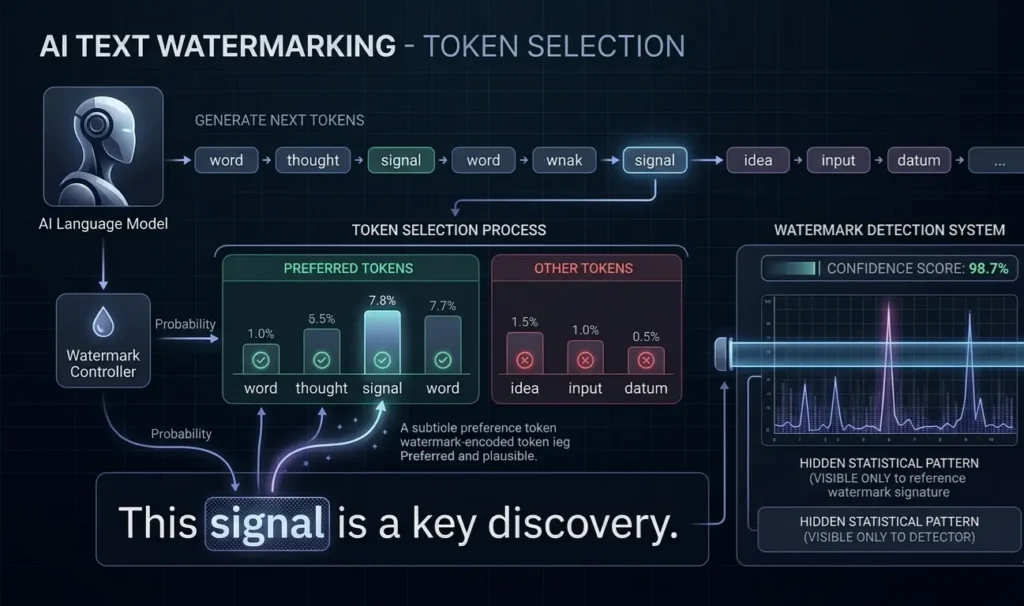
One of the best-known approaches to LLM watermarking uses the idea of a green list and a red list.
Don’t take these names literally.
The words are not actually colored inside your document.
They represent two groups of possible tokens.
Suppose a model has 100 possible tokens available at a particular moment.
A watermarking algorithm might secretly divide them into two groups:
Green list: tokens that receive a slight preference.
Red list: tokens that do not receive that preference.
The model can still select a red-list token.
That is important.
A watermark does not necessarily mean:
“Only choose green words.”
Instead, it can mean:
“When several reasonable choices exist, slightly increase the chance of selecting certain tokens.”
Research on the original green-list approach describes this type of watermark as changing token probabilities during generation.
Why Doesn’t This Make Claude’s Writing Look Strange?
This is probably the biggest question people have. If the system is quietly changing word choices, shouldn’t the writing end up sounding unnatural?
Not necessarily.
Modern language models have plenty of different ways to express the exact same idea. For example, “the technology is changing rapidly” could just as easily become “the technology is evolving quickly.” Both sentences make perfect sense. The watermarking mechanism can operate in situations where there are several reasonable options sitting on the table.
When there’s really only one obvious answer, though, changing the choice could actually hurt quality. That’s one reason modern watermarking research focuses so heavily on preserving text quality rather than forcing changes everywhere. Google’s SynthID-Text research, for example, describes a production-oriented approach that adjusts sampling rather than retraining the entire language model from scratch.
The exact implementation Anthropic uses is different, and it hasn’t been fully disclosed publicly. So we shouldn’t assume Claude runs Google’s exact SynthID-Text algorithm — it’s a related idea, not necessarily the same system.
The Watermark Is About Statistics, Not a Secret Sentence
This point is worth holding onto. A common misunderstanding is that Anthropic might be hiding something like “this text was generated by Claude” inside every single response. That’s not really how this type of watermark tends to work.
There doesn’t need to be a hidden sentence anywhere. Instead, imagine a long article containing 2,000 tokens. Each individual word looks completely ordinary on its own. But the statistical relationship between thousands of small choices, taken together, may carry a detectable signal.
A detector with the right verification method can then ask a fairly simple question: is this pattern more consistent with watermarked Claude output than with ordinary text? That’s a very different process from just scanning for hidden characters somewhere in the file.
How Can the Watermark Survive Copy and Paste?
This is where the Claude watermark gets particularly interesting.
Suppose Claude generates 1,500 words. You copy the text out of Claude, then paste it into Microsoft Word. The text itself stays exactly the same. If the watermark is embedded in the statistical pattern of token choices, copying and pasting doesn’t regenerate those tokens from scratch — the underlying sequence just gets transferred somewhere else, unchanged.
Anthropic says its watermark is designed to stay detectable after common actions like copying, pasting, and minor editing. That doesn’t mean the watermark is impossible to remove entirely, though. Heavy rewriting, translation, or mixing the original output with a substantial amount of new text can weaken or potentially destroy the signal altogether. Current reporting notes these same limitations too.
So the realistic picture looks something like this: copying likely survives, pasting likely survives, minor edits may survive, heavy rewriting may weaken the signal, and major paraphrasing or translation may make it difficult or even impossible to detect. The exact detection threshold will really depend on whatever technical documentation and detector Anthropic eventually releases.
Claude Watermark vs a Normal AI Detector
This distinction matters a lot for writers specifically.
An AI detector and a watermark detector aren’t necessarily doing the same job. Imagine two articles side by side.
Article A: a human writes the article completely from scratch. An AI detector analyzes it and says “78% likely AI-generated.” That doesn’t actually prove Claude generated it — it’s just a probabilistic guess based on writing patterns.
Article B: Claude generates an article that contains its watermark. A compatible watermark detector may be able to identify that embedded signal directly. That’s a much closer thing to actual provenance than a guess ever could be.
Here is the difference:
This is why a watermark should not automatically be described as an “AI detector.”
They solve related but different problems.
What Happens If You Ask Claude to Edit Human Writing?
This is one of the most controversial parts of the whole technology.
Imagine you write a 2,000-word article entirely yourself. You then hand it to Claude and say, “fix my grammar and spelling.” Claude processes the text. So what happens next?
According to current reporting about Anthropic’s system, Claude’s watermarking can apply to content that’s been processed by Claude at all, which has raised real concerns among writers and developers about how AI-assisted work ends up getting classified.
This creates an important distinction between AI-generated content and human-created content that was simply AI-assisted along the way. Those two things aren’t necessarily the same at all.
For example: a human writes an article, and Claude fixes five spelling mistakes. A human writes code, and Claude suggests a small optimization. A human writes an email, and Claude just improves the grammar. A human writes a report, and Claude translates it into another language.
In every one of these cases, the human contribution may genuinely be substantial. Yet AI processing could still potentially leave a machine-readable mark behind. That’s exactly one reason the Claude watermark has stirred up debate among developers, writers, and other Claude users.
Is the Claude Watermark Impossible to Remove?
No, and this is another important misconception worth clearing up.
No responsible explanation should claim that an AI watermark is permanently glued to a piece of text forever. Text is fundamentally different from a physical object in that sense. You can rewrite it. You can translate it. You can combine it with another article. You can delete sentences. You can completely restructure it from top to bottom.
Any of these actions can reduce the statistical evidence available to a detector. Anthropic itself has acknowledged real limitations around the watermark’s ability to survive substantial transformations like these.
This sets up a constant tension between watermark robustness on one side and text transformation on the other. The stronger a watermark becomes, the more researchers have to worry about whether it starts affecting writing quality. The weaker it becomes, the easier it may be for a bit of serious rewriting to destroy the signal entirely.
Claude Watermark vs Google SynthID
Anthropic isn’t the first company to explore invisible AI watermarks, not by a long shot.
Google DeepMind has already developed SynthID-Text, a watermarking technology built specifically for AI-generated text. Google’s research describes a system that modifies the sampling process used during text generation and relies on a statistical signal that can be detected later on.
There’s an important difference in public information between the two, though. Google has published actual technical research and a reference implementation for SynthID-Text, out in the open. Anthropic, on the other hand, has confirmed that its Claude watermark exists, but hasn’t yet published all of the technical details behind how its own implementation actually works.
Quick Comparison
Google’s official documentation also describes SynthID detection as probabilistic, which is an important reminder that watermark detection should not automatically be treated as absolute proof in every circumstance.
Watch: How AI Text Watermarking Works
If you want to understand the token-level side of AI watermarking, this visual explanation can help:
Watch: LLM Watermarking Explained
The video is useful because the concept is easier to understand when you can actually see how token probabilities and watermark signals relate to one another.
For readers who want to go deeper, Google’s technical work on SynthID-Text is also worth reading.
What Does This Mean for AI Writers?
For bloggers, the arrival of the Claude watermark doesn’t mean AI-assisted writing has suddenly become useless. It means the relationship between AI tools and content ownership is simply becoming more transparent.
If you use Claude to brainstorm, human contribution still remains front and center. If you use Claude to generate an entire article outright, the output may well carry a machine-readable signal. If you use Claude to edit your own existing work, the situation gets a bit more complicated to untangle.
That distinction is going to matter more and more as publishers, schools, companies, and online platforms build out their own AI policies. For bloggers like me over at AI Tech Pulse, the practical lesson is simple: use AI as a tool, but keep your own research, judgment, editing, experience, and voice sitting at the center of the content. AI can help you work faster — it doesn’t automatically replace the value of real human expertise.
The Bigger Question Underneath All of This
The technology behind the Claude watermark is genuinely fascinating, but the bigger story here isn’t really about detecting AI at all. It’s about content provenance more broadly.
In the future, the internet could easily contain billions of pieces of AI-generated text. Search engines, publishers, schools, businesses, and everyday readers may all want better ways to understand where that content actually came from. A machine-readable watermark could become one piece of that larger puzzle.
But it’s unlikely to ever be perfect. Watermarks can weaken over time. Text can be transformed beyond recognition. Detection stays probabilistic rather than certain. And human-AI collaboration makes the question of “who actually wrote this?” a lot harder to answer than a simple yes-or-no label ever could.
Key Takeaway
The simplest way to remember all of this is: the Claude watermark isn’t necessarily a hidden word or an invisible character sitting somewhere in the text. It’s an imperceptible signal tied to how the text was generated in the first place.
Modern LLM watermarking can influence token-selection probabilities so that a statistical pattern shows up across a large enough stretch of generated text. The reader just sees normal writing. A compatible detection system can then potentially go looking for that hidden statistical pattern underneath it. And because the signal is tied to the generated text itself rather than a visible label stuck on top, ordinary copy-and-paste operations don’t necessarily remove it.
That said, Anthropic hasn’t yet disclosed the complete technical mechanism behind its Claude watermark, so any claims about the exact algorithm should be treated with a fair bit of caution.
What the Claude Watermark Means for Writers, SEO, and the Future
So far, we’ve covered what the Claude watermark actually is, along with the basic idea behind how an invisible statistical signal can be tied to AI-generated text.
But for most people, the technical explanation is really only half the story. The bigger question is: what does all of this actually mean for people who use Claude every day?
If you’re a blogger, student, developer, marketer, journalist, researcher, or content creator, the arrival of invisible AI watermarks could eventually change how AI-assisted content gets created and verified across the board.
At AI Tech Pulse, I think the most useful thing to do is look at this technology realistically. It’s neither some magical AI detector, nor something that automatically makes AI-assisted writing bad. It’s simply another layer of technology designed to offer more information about where digital content actually came from.
Can You Detect a Claude Watermark Yourself?
Probably not, just by looking at the text.
This is one of the biggest differences between a traditional watermark and a statistical AI watermark. If you open up a Claude response and read through it carefully, you won’t see any special mark. There may be no unusual character anywhere. There may be no hidden sentence tucked in. There may be no visible label of any kind.
The signal is meant to be detected computationally, not visually — which is exactly why looking harder simply won’t help.
Watch: How AI-Generated Content Can Be Watermarked and Identified
That means tools designed specifically to verify the watermark would be much more useful than simply copying the text into a normal AI detector.
This distinction matters because people often assume that every AI detector can identify every AI watermark.
That is not true.
A general AI detector may estimate whether writing looks AI-generated.
A watermark verification system is looking for a particular signal associated with a generation system.
Can Google Actually Detect a Claude Watermark?
This is a question a lot of bloggers are already asking.
The short answer is: don’t assume Google Search automatically reads or uses the Claude watermark as a ranking signal, because right now there’s no solid public evidence showing that.
There’s currently no solid public evidence showing that Google Search automatically takes Anthropic’s Claude watermark and uses it as a direct ranking factor. Google does have its own AI-content and watermarking research, including SynthID, but that doesn’t mean Google automatically has access to every third-party watermark system out there.
Google’s public guidance has generally focused on the quality and purpose of content rather than simply whether AI was involved in producing it at all. For website owners, that’s actually an important distinction to hold onto. Using AI doesn’t automatically mean a page is bad — low-quality, unhelpful, repetitive, or misleading content is the real problem here, regardless of who or what wrote it.
Google’s guidance around AI-generated content emphasizes creating helpful, reliable, people-first content, rather than fixating only on whether AI was used somewhere in the process. So bloggers really shouldn’t panic about the Claude watermark and assume a watermarked article will suddenly vanish from Google overnight.
Does the Claude Watermark Hurt SEO?
There’s currently no strong evidence that simply having a Claude watermark causes a page to take an automatic SEO penalty.
SEO is a lot more complicated than a simple “AI equals bad” or “human equals good” equation. Search engines weigh plenty of different signals at once. For a blogger, the more useful approach is focusing on original information, accurate facts, clear explanations, helpful structure, a good overall user experience, strong internal linking, relevant external references, human editing, firsthand insight wherever possible, accurate titles and descriptions, and simply avoiding mass-produced, low-value pages.
If you use Claude to help research or organize an article, the final content still needs to deliver genuine value on its own merits. That matters even more for smaller websites going up against established publishers with bigger teams.
So What Should Bloggers Actually Do?
For bloggers, the arrival of the Claude watermark isn’t really a reason to stop using AI altogether. It’s a good reason to become more intentional about how you’re actually using it.
There’s a huge difference between saying “Claude, write me a 3,000-word article, and I’ll publish it exactly as you hand it back to me” versus “I researched this topic myself, collected sources, added my own examples, used Claude to help organize the information, checked the facts, rewrote sections, and edited the final article personally.”
The second workflow puts the human much more firmly in control of the outcome. That matters because AI can genuinely make mistakes — it can misunderstand a source, repeat outdated information without realizing it, confidently explain something incorrectly, and produce generic writing that sounds polished on the surface but doesn’t actually say very much underneath.
So the best workflow isn’t simply AI, then publish. It’s research, then AI assistance, then fact-checking, then human editing, and only then publishing.
A Better AI Writing Workflow for 2026
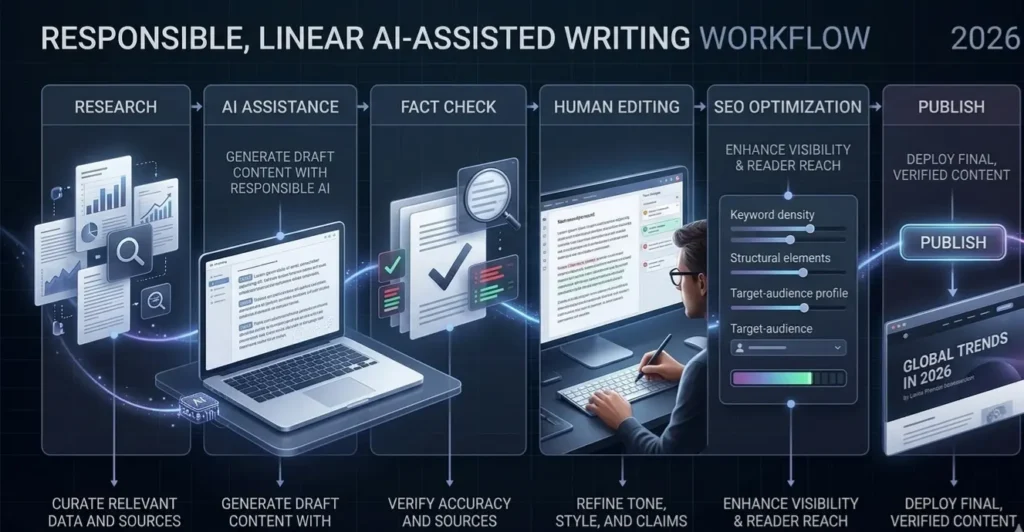
Here is a practical workflow that bloggers can use.
This approach is useful whether you use Claude, ChatGPT, Gemini, or another AI writing tool.
The tool should support the writer.
It should not replace the writer’s judgment.
Can Editing Actually Remove a Claude Watermark?
This question is more complicated than it might first sound.
A small edit may not necessarily destroy a statistical watermark at all. For example, changing “AI is changing the world” to “artificial intelligence is changing our world” doesn’t completely rewrite the underlying content — it’s still largely the same material underneath.
But substantial rewriting can reduce the amount of original watermarked material left standing. Translation, heavy paraphrasing, sentence restructuring, combining multiple sources together, or replacing large chunks of the text can all potentially weaken a watermark’s signal.
This is really one of the fundamental challenges of text watermarking as a field. A watermark needs to be robust enough to survive everyday, normal use, but it also has to preserve the quality and flexibility of the generated text itself. Researchers have repeatedly studied this trade-off between watermark robustness on one hand and the attacks or transformations that try to weaken the signal on the other.
So the honest answer sits somewhere in the middle: a Claude watermark shouldn’t be treated as impossible to modify or remove, but it also shouldn’t be treated as something that vanishes instantly the moment you change a single word.
What About Human + AI Collaboration?
This might end up being one of the biggest debates surrounding AI watermarks going forward.
Imagine a writer spends three hours researching an article. They write 90% of it themselves. Then they use Claude to improve the grammar, rewrite a couple of paragraphs, and suggest a better headline. Is the final article AI-generated?
There’s no simple answer to that. This is exactly why provenance systems can end up being a lot more complicated than simple AI detection ever was.
The future of writing is likely to include many different levels of AI assistance — human only, AI brainstorming, AI editing, AI translation, AI research assistance, AI-assisted drafting, mostly AI-generated, and fully AI-generated. A simple watermark may just tell us that an AI system participated somewhere in the content-generation process. It may not tell us exactly how much of the actual work was done by that AI. That distinction is going to matter a great deal for schools, publishers, employers, and online platforms trying to draw sensible lines.
Privacy Concerns Around AI Watermarks
There’s another side to this story that deserves real attention.
AI provenance can be genuinely useful, but people may also reasonably worry about how that kind of information gets used down the line. Imagine a system that can reliably determine a person used Claude to help write a document. Who actually gets access to that information — a website, a school, an employer, a platform? Could it end up being used against someone even in cases where the AI assistance was perfectly legitimate and disclosed?
None of this necessarily means watermarking itself is a bad idea. It simply shows why transparency systems need clear rules around them. A watermark can provide information about a piece of content’s origin — it shouldn’t automatically turn into a judgment about the person who created or edited that content.
The Advantages of Claude Watermarking
There are several potential upsides worth naming here.
Better content transparency. Readers and organizations gain another way to understand whether AI was involved in producing a piece of content.
Easier provenance. Publishers could potentially use watermark signals as one part of a much larger content-provenance system, rather than relying on guesswork alone.
Reduced confusion. As AI-generated content becomes more and more common, provenance information could help people tell different types of digital content apart.
More responsible AI development. Watermarking can push AI companies to take greater responsibility for how the content their models generate moves around the internet afterward.
Support for digital trust. In certain situations, simply knowing where a piece of content actually came from could become increasingly valuable over time.
The Disadvantages and Limitations
The technology also has weaknesses.
This is why the Claude watermark should be viewed as a tool rather than an absolute truth machine.
No single detection technology can completely solve the AI-content problem.
Will AI Watermarks Become Normal?
I think they probably will.
The direction of the industry is already clear.
AI-generated images, videos, audio, and text are becoming increasingly difficult to distinguish from human-created material.
That makes provenance more valuable.
We are likely to see more systems that attempt to answer questions such as:
Who created this?
Which AI system generated it?
Was it edited?
When was it created?
Has it been modified?
The Claude watermark is one example of this broader movement.
Google has its SynthID technology.
Other companies and research groups are exploring their own approaches.
Over time, these systems could become part of a larger digital-content authenticity ecosystem.
Watch: The Future of AI Watermarking
For a deeper look at how AI watermarking works, this video provides useful background on LLM watermarking and the challenges involved:
Watch: LLM Watermarking Explained
If you want the research side rather than a general explanation, Google’s SynthID-Text work is also worth reading because it demonstrates how statistical watermarking can be implemented during text generation.
Claude Watermark: What Writers Should Remember
If you are a writer using Claude in 2026, there are a few simple lessons worth remembering.
First: don’t assume an AI detector and a watermark detector are the same thing.
Second: don’t assume the watermark automatically means your content will be penalized by Google.
Third: don’t assume a watermark can never be weakened by editing.
Fourth: don’t assume that AI-assisted content and fully AI-generated content are identical.
And finally:
Don’t publish blindly.
If AI helps you write, your responsibility for the final article still matters.
Check the facts.
Add original value.
Use trustworthy sources.
Improve the structure.
Make the writing useful for real people.
That is a much stronger content strategy than simply trying to make AI-generated text look human.
Claude Watermark FAQs
What is a Claude watermark?
A Claude watermark is an imperceptible, machine-readable signal associated with text generated by Claude. It is designed to help identify AI-generated content without placing a visible mark inside the text.
Can I see the Claude watermark?
No. It is designed to be invisible to normal readers. Detection requires an appropriate technical verification system.
Does every Claude response have a watermark?
Anthropic has said its watermarking is applied at the model level across Claude deployments, but users should not assume that every possible piece of text will always be successfully detectable after significant transformation.
Can copying and pasting remove the watermark?
Copying and pasting alone does not necessarily remove a statistical watermark. However, substantial rewriting, paraphrasing, translation, or other transformations may weaken the signal.
Does the Claude watermark prove that a human did not write something?
Not necessarily.
A watermark can potentially indicate that Claude participated in generating or processing text, but it does not automatically tell you how much of the final work came from AI or how much came from a human.
Is the Claude watermark the same as an AI detector?
No.
An AI detector usually estimates whether text appears machine-generated. A watermark is intentionally embedded during the AI generation process and can be checked using a compatible detection method.
Will Google penalize watermarked Claude content?
There is no good public evidence that simply having a Claude watermark automatically causes a Google Search penalty. Website owners should focus on creating helpful, original, trustworthy and people-first content.
Can writers still use Claude for blogging?
Yes.
The important issue is how the tool is used. Research, brainstorming, outlining, editing, and other forms of AI assistance can be part of a responsible writing workflow. The final content should still be accurate, useful, and genuinely valuable.
Final Verdict: Is the Claude Watermark Good or Bad?
The Claude watermark isn’t automatically good, and it isn’t automatically bad either. It’s a technology built to solve a genuinely real problem.
AI-generated content is growing extremely fast, and it’s becoming harder and harder to figure out where a given piece of digital content actually originated. Invisible watermarking could provide one more piece of evidence in that puzzle.
But it’s far from perfect. It can’t necessarily tell us how much AI was actually used in a piece. It may weaken after substantial editing. Detection won’t always be certain. And the exact technical implementation behind Anthropic’s version isn’t fully public yet.
For writers and bloggers, the biggest lesson here isn’t to become obsessed with hiding or removing AI signals from your work. The better strategy is simply to create better content in the first place. Use AI when it genuinely helps. Do your own research. Check the important claims yourself. Add your own personal insight. Give readers something useful that they can’t get from a generic AI response anywhere else.
That’s the approach I want to keep following here at AI Tech Pulse as this technology keeps evolving.
The future of content probably won’t be completely human or completely AI — it’ll be a mixture of both. And technologies like the Claude watermark are likely to become just one part of that new digital-content landscape taking shape.
Quick Summary
Final Thought
The internet is entering a genuinely new phase right now.
For years, the main question was simply “can AI write like a human?” Now another question is becoming just as important: “can we actually tell where this content came from?”
The rise of the Claude watermark shows that AI companies are starting to take that second question seriously too, not just the first one. Whether invisible watermarks end up becoming some kind of universal standard remains to be seen. But one thing is already pretty clear: AI-generated content is no longer just about generation anymore. It’s also becoming a question of provenance, transparency, and trust.
And for anyone creating content in 2026, that’s a shift genuinely worth paying attention to.