
Keeping up with AI model releases these days can honestly feel like a full-time job on its own. Developers had barely gotten settled into Gemini 3.6 Flash, and Google was already back with another major update.
On August 13, 2026, Google rolled out Gemini 3.7 Flash, calling it its most intelligent workhorse model yet for coding and AI agents. What really stands out here is the timing — this new model landed barely three weeks after Gemini 3.6 Flash shipped.
At AI Tech Pulse, we’ve been watching closely as AI keeps shifting from simple chatbots into systems that can actually reason, use tools, write code, work across different formats, and complete tasks with barely any hand-holding. Gemini 3.7 Flash fits right into that pattern.
So what actually makes this one different?
In this guide, we’re breaking down seven standout features of Google Gemini 3.7 Flash and looking at what they could mean for developers, businesses, creators, and everyday AI users as 2026 rolls on.
What Is Google Gemini 3.7 Flash?
Google Gemini 3.7 Flash is the newest entry in Google’s Gemini Flash lineup. Unlike models built mainly to fire back quick answers, 3.7 Flash is heavily built around reasoning, coding, agentic workflows, web development, and knowledge work.
Google’s calling it a workhorse model built for complex tasks — and once you look at what it can actually handle, that framing makes a lot more sense.
Gemini 3.7 Flash takes text, images, video, audio, and PDF files as input, and it supports tools like function calling, search grounding, code execution, file search, and computer use in preview. It also comes with a 1-million-token input context window and can output up to 65,536 tokens, according to Google’s own developer documentation.
That combination actually matters, because modern AI work has moved well past simply asking a question and getting a one-line answer back.
A genuinely useful AI agent today needs to do a lot more than that. It might need to work through a large number of files, make sense of screenshots, go search for relevant information, write and test its own code, reach for outside tools when the situation calls for it, troubleshoot problems as they pop up, follow a long sequence of steps without losing track, and stay anchored to the original goal the whole way through.
Gemini 3.7 Flash is built with exactly that kind of workflow in mind.
Google Gemini 3.7 Flash at a Glance
Gemini 3.7 Flash
Advanced Reasoning & Multimodal Capability
Main Focus
Coding, Autonomous Agents, & Complex Knowledge Work
Model Type
Reasoning and Advanced Multimodal AI
Supported Inputs
Input Context Window
Up to 1 Million Tokens
Maximum Output
Up to 64K Tokens
Thinking Levels
This isn’t just some research experiment sitting in a lab somewhere — the model is generally available right now. Google lists Gemini 3.7 Flash as production-ready on its developer platform, meaning teams can actually build on it today.
1. Advanced Reasoning With Adjustable Thinking
One of the more genuinely important upgrades in Gemini 3.7 Flash is how it handles reasoning.
Rather than treating every single question the exact same way, the model now lets developers dial its thinking effort up or down. Google offers three thinking levels — low, medium, and high — which hands developers a lot more control over the tradeoff between quality, cost, and response speed. Google’s own model card specifically calls out these customizable thinking configurations as the way to manage that balance.
Why does adjustable thinking actually matter?
Say you ask an AI to rewrite a short email. You really don’t need it burning through heavy computation to think that through — it’s a simple task, and speed matters more than depth here.
Now compare that to asking it to analyze a large software project, track down a bug, plan out a fix, modify several files, test those changes, and then explain what actually happened. That’s an entirely different kind of problem, and it deserves a different level of effort.
A higher thinking level makes sense for the complicated stuff. A lower one makes sense when speed and efficiency matter more than squeezing out every bit of reasoning. That flexibility is really what sets Gemini 3.7 Flash apart from a model that’s simply “fast” or simply “slow” — it can actually be both, depending on what you ask of it.
A Simple Example
Gemini 3.7 Flash: Thinking Levels
When to utilize Low, Medium, or High Thinking Parameters
| Task Operational Type | Suggested Thinking | Why This Level? |
|---|---|---|
| Rewrite a short paragraph | Low | Simple task requiring fast, standard linear responses. |
| Summarize a document | Low – Medium | Moderate reasoning needed to extract foundational core facts. |
| Analyze business data | Medium | More context window is required to spot subtle vectors & trends. |
| Debug complex code | Medium – High | Requires deeper analytical reasoning to trace logical software path errors. |
| Multi-step AI agent workflow | High | Planning and advanced cross-tool use matter for long-horizon execution. |
The key thing to keep in mind is that more thinking isn’t automatically better across the board. For developers, being able to tune this setting means you’re not burning resources on deep reasoning for tasks that never needed it in the first place.
What This Could Mean in 2026
AI seems to be heading toward a world where users won’t have to manually pick a model mode every single time. Instead, applications themselves can decide how much reasoning a given task actually deserves.
A customer-support question might get a lighter setting. A complicated coding task might reach for something heavier. An AI agent juggling multiple tools at once might need something even more deliberate than that. That’s a big part of why adjustable thinking could end up becoming a much bigger piece of how AI applications get designed going forward.
2. Much Stronger Coding and Software Development
If there’s one area where Google is clearly putting its weight behind Gemini 3.7 Flash, it’s coding.
Google says the model brings real improvements to software engineering — better debugging, stronger issue resolution, higher first-pass accuracy, and code that’s closer to production-ready right out of the gate.
The benchmark numbers back that up in a way that’s hard to ignore. On Google’s own FrontierCode 1.1 Main evaluation, Gemini 3.7 Flash scored 43.6%, compared to 34.4% for Gemini 3.6 Flash. On DeepSWE v1.1 — which focuses specifically on long-horizon software engineering work — 3.7 Flash hit 65.3%, up from roughly 49% on the previous model.
That’s not a small bump. That’s the kind of jump that actually changes what the model is realistically capable of handling.
Gemini 3.7 Flash vs Gemini 3.6 Flash for Coding
Gemini 3.7 Flash: Performance Benchmarks
Comparing Next-Gen Speed & Accuracy Against Previous Iterations
| Benchmark Metric | Gemini 3.7 Flash | Gemini 3.6 Flash |
|---|---|---|
| FrontierCode 1.1 Main Coding and logical evaluation | 43.6% 🏆 Winner | 34.4% |
| DeepSWE v1.1 Software Engineering capabilities | 65.3% 🏆 Winner | 48.6% |
| Code Arena Web Development Live environment web building score | 1588 Elo 🏆 Winner | 1538 Elo |
| Terminal-Bench 2.1 CLI environment & OS automation tasking | 85.8% 🏆 Winner | 78.0% |
| AutomationBench Long-horizon agent planning execution | 30.4% 🏆 Winner | 17.0% |
Worth keeping in mind: these are Google’s own reported evaluation results, so they’re best treated as vendor-reported benchmark comparisons — not a guarantee that Gemini 3.7 Flash will beat every other model at every real-world coding task you throw at it. Google grading its own homework is still Google grading its own homework.
That said, the direction is clear. Google is clearly trying to push Flash models beyond just spitting out small snippets of code.
What Can Gemini 3.7 Flash Actually Do With Code?
A genuinely strong coding model shouldn’t just produce code — it needs to actually understand the problem sitting behind that code.
Picture a developer asking an AI to inspect an existing project, track down a bug, explain what’s causing it, suggest a fix, go modify the relevant files, run the tests, fix whatever breaks if a test fails, and then explain what it actually changed at the end.
That’s a lot closer to how a real developer actually works day to day — not one clean request-and-response, but a whole messy back-and-forth process.
Google says Gemini 3.7 Flash has gotten better at following instructions, adapts more sensibly when it hits a roadblock, and puts more effort into multi-step planning and tool calls. That matters more than it might sound, because coding agents don’t usually fail because they can’t write code — they fail because they lose track of what they were actually trying to accomplish halfway through.
From Code Generation to Coding Agents
This is where the word “agentic” starts to actually mean something.
A traditional AI coding assistant hands you a code snippet and calls it done. A coding agent tries to understand the actual goal and works through however many steps it takes to get there. Gemini 3.7 Flash is clearly built for that second category — Google DeepMind describes it as optimized for complex agentic tasks, including software engineering, web development, and knowledge work.
Why Developers May Actually Care
The real advantage here probably isn’t that it can write code — plenty of models can already do that. The question that actually matters is: how much human correction does the code need before it’s genuinely usable?
If a model produces better first-pass results, understands existing codebases instead of working in isolation, follows design references accurately, and recovers gracefully from its own errors, developers can spend less time cleaning up after it. Google specifically points to better first-pass accuracy and fewer failed agent loops as part of what’s improved here.
That could genuinely matter for web developers, app developers, startup teams, software engineers, AI automation builders, students learning to code, and small businesses trying to build their own internal tools without a full engineering team behind them.
Gemini 3.7 Flash and Web Development
Coding is only half of it. Google’s also reporting solid improvements in web development and UI generation specifically.
On the WebDev Arena evaluation, Gemini 3.7 Flash landed an Elo score of 1588, up from 1538 for Gemini 3.6 Flash. Google says the model can now generate more functional layouts and closer-to-complete applications with fewer prompts needed to get there.
That opens up something pretty interesting. Someone could hand the AI a screenshot, a design reference, or just a written description, and ask it to turn that into an actual working web interface.
The ask here isn’t really “make me a website.” It’s closer to “understand this design, reproduce the structure, stick to the visual system, build out the components, and make sure the end result actually works.” That’s a much harder task than it sounds — and it’s exactly the kind of workflow Google is putting front and center with Gemini 3.7 Flash.
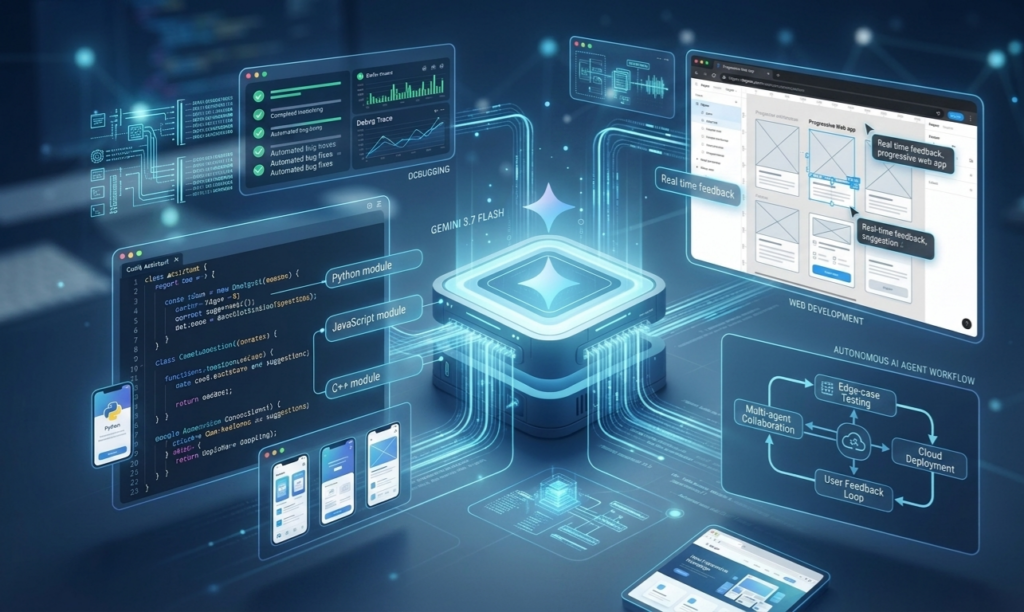
Watch: Gemini 3.7 Flash in Action
The best way to understand the difference between a normal chatbot and an agentic coding model is to see one actually work.
Google’s official Gemini 3.7 Flash material demonstrates workflows such as turning a simple prompt into a playable game, generating web experiences, working with PDFs, and coordinating multiple agents.
Recommended video title:
Introducing Gemini 3.7 Flash — Google’s New AI Workhorse
What We Have Learned So Far
The first two features already show why Google Gemini 3.7 Flash is getting attention in 2026.
It is not simply another chatbot upgrade.
The bigger story is the combination of:
- More controllable reasoning
- Better coding
- Stronger debugging
- Better multi-step execution
- Improved web development
- More reliable tool use
3. AI Agents That Can Handle Multi-Step Tasks
Traditional chatbots usually work in a pretty simple loop: you ask, the AI answers, and the conversation ends there.
AI agents work differently. An agent can take a goal, break it down into smaller steps, reach for tools when it needs them, work through problems as they come up, and keep going until the task is actually finished — not just answered.
This is one of the biggest areas Gemini 3.7 Flash is built to improve on. Google describes it as its most intelligent Flash workhorse yet for coding and agents, with stronger performance across agentic workflows and multi-step execution.
What Is an AI Agent, Really?
Say you tell an AI: “Research five competitors, compare their pricing, organize the information into a report, and highlight the cheapest option.”
A basic chatbot would probably just give you a response based on whatever it already knows off the top of its head. An AI agent can actually go search for the information, open the relevant sources, pull out the useful details, compare what it finds across each one, organize the data, put together a report, check its own work, and hand you back the final result.
The important part isn’t that the AI is generating text — it’s that it’s actually carrying out a workflow, start to finish.
If you’re curious about how AI coding tools are reshaping software development more broadly, our guide to AI coding tools digs into that further.
Why Gemini 3.7 Flash Is Interesting for Agents Specifically
Google says the model puts more effort into multi-step planning and tool calls, and it’s also built to adapt better when it hits a roadblock — which, in practice, can mean less need for a human to keep stepping in to restart or correct the agent mid-task.
The model supports a solid range of tools through Google’s developer platform, including function calling, search grounding, code execution, file search, computer use, URL context, and Google Maps grounding. The official Gemini API documentation lists all of these capabilities for Gemini 3.7 Flash directly.
AI Agent Workflow Example
Gemini 3.7 Flash: Agentic Workflow
How Autonomous AI Agents Execute Long-Horizon Multi-Step Tasks
Understands the Goal
The AI analyzes the macro intent, parses constraints, and locks onto the desired final state.
Creates a Plan
Breaks down the complex, long-horizon task into smaller, sequential sub-tasks.
Uses Tools
Actively interacts with environment components via sandboxed or production APIs.
Processes Information
Synthesizes data inputs, filters out noise, and compares cross-channel results.
Handles Problems
Self-corrects dynamically in real-time when a tool breaks or code runtime errors surface.
Produces Output
Assembles final artifacts and marks the primary instruction loop as completed.
This is why agentic AI could become much more important in 2026.
The value of AI is slowly moving away from “How good is its answer?” toward another question:
“How much useful work can it complete for me?”
Gemini 3.7 Flash Can Work With Other Agents
One particularly interesting Google demonstration combines Gemini 3.7 Flash with other models and agents.
Google showed an example where Gemini 3.7 Flash orchestrates sub-agents to create interactive web experiences. It has also demonstrated a robotics workflow using Gemini 3.7 Flash in a three-agent graph loop.
This points toward a future where one AI model does not necessarily have to do everything.
Instead, one model could act as the planner or coordinator, while other specialized models handle specific jobs.
For example:
Multi-Agent Collaboration Flow
How a master coordinator orchestrates specialized autonomous sub-agents to achieve a unified outcome.
Main AI Agent
Search Agent
Gathers market research and dynamic web logs.
Code Agent
Compiles logic structures and application DOM trees.
Design Agent
Manages visual hierarchy and typography elements.
Final Result
That type of architecture could become common in business automation, software development and research.
Watch: Google Gemini 3.7 Flash Agent Demo
A good way to explain agentic AI to readers is to show Google’s own demonstrations.
Google DeepMind’s Gemini 3.7 Flash page includes examples of multi-agent workflows, interactive web experiences and multimodal agent tasks.
YouTube title:
Gemini 3.7 Flash — AI Agents and Real-World Workflows
For readers who want to build their own AI applications, the official Google Gemini API documentation is also worth checking out.
4. Better Web and App Development
The fourth major feature is something that could be especially useful for developers, designers and startup founders.
Google Gemini 3.7 Flash is much better at turning ideas and visual references into working web experiences.
Google reports that the model produces more functional layouts and feature-complete applications with fewer prompts than Gemini 3.6 Flash. It also shows stronger design adherence when working from screenshots, images or complete design systems.
That means you can think beyond traditional code generation.
Instead of saying:
A developer could provide a screenshot or design reference and ask the model to reproduce the layout.
The AI has to understand:
- Page structure
- Spacing
- Components
- Typography
- Visual hierarchy
- Navigation
- Buttons
- Responsive behavior
- Overall design style
From Screenshot to Working Website
This is where the technology gets exciting for small businesses.
Imagine a business owner has a screenshot of a website they like.
They may not know:
- HTML
- CSS
- JavaScript
- React
- APIs
- responsive design
With a capable AI coding system, the owner can describe what they want and provide the reference.
The model can then help turn that idea into a working interface.
Google’s own demonstrations show Gemini 3.7 Flash being used to create interactive landing pages and web experiences, including workflows where it coordinates sub-agents.
Web Development Comparison
Development Workflow Comparison
Traditional Manual Engineering vs Next-Gen AI-Assisted Implementation
Of course, AI-generated websites still need human review.
A model can create impressive code and still make mistakes in accessibility, security, responsiveness or business logic.
So the smarter approach is not:
“AI replaces the developer.”
It is:
“AI helps the developer move faster.”
Why This Matters for Small Businesses
This feature could be especially useful for people who need a website but cannot afford a large development team.
A small business might be able to use AI to create:
- Landing pages
- Product pages
- Marketing websites
- Internal dashboards
- Simple web applications
- Prototypes
- Interactive demos
That does not mean every AI-generated website will be production-ready.
But the distance between an idea and a working prototype is getting much smaller.
And that is a major shift.
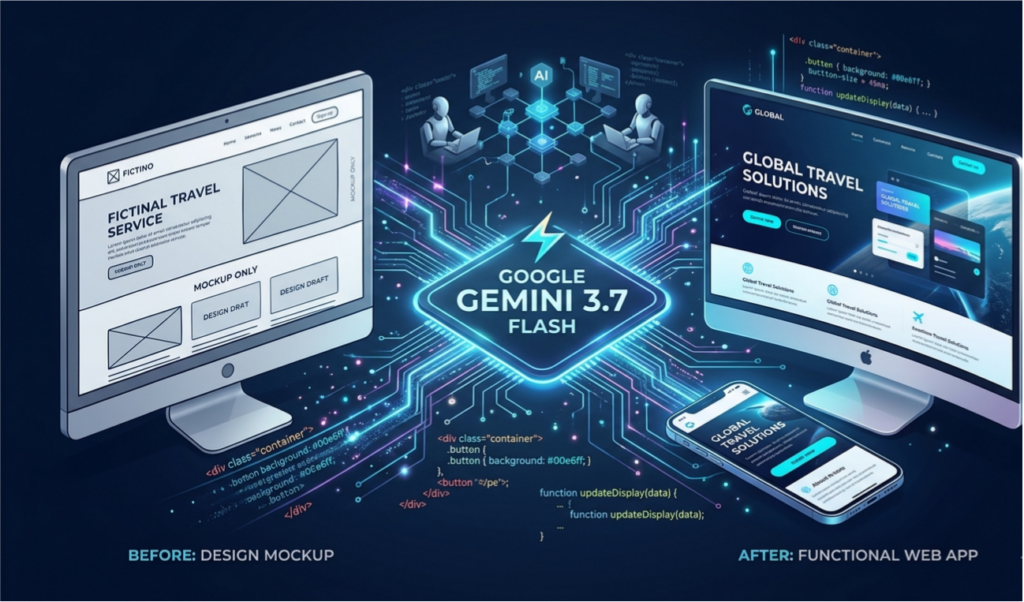
Google Gemini 3.7 Flash and Design Accuracy
One of the more interesting improvements is not just generating a website but matching a reference design more closely.
Google says Gemini 3.7 Flash can work from screenshots, images and design systems, and it has improved design adherence when generating web applications.
This could be useful when a developer already has a visual design but needs to turn it into code.
For example:
How Image-to-Code Pipeline Works
A simple step-by-step breakdown of turning a static concept design into a working web application.
Screenshot Input
The user uploads or feeds a visual mockup of the website UI.
Gemini 3.7 Flash Analysis
The multimodal AI scans the elements, padding, and layout structure.
Analyze Layout
The system maps headings, image boxes, grids, and typography styling.
Generate Code
Translates visual sections into clean, semantics-ready HTML, CSS, and JS code.
Compare with Reference
Cross-checks the built environment against the source image to fix spacing anomalies.
Final Interface Delivery
Deploys a completely functional, pixel-perfect web application layer.
That last step is important.
The ability to compare the generated result with the original design can reduce the amount of manual tweaking required.
For professional development teams, even small improvements in this process can save hours.
5. Truly Multimodal Understanding
Now we reach one of the most important features of Google Gemini 3.7 Flash.
It is not limited to text.
The model is natively multimodal and can work with:
- Text
- Images
- Video
- Audio
- PDF documents
Google’s official model information lists these as supported inputs, with up to a 1-million-token context window.
That means Gemini 3.7 Flash can process information from several different formats within the same AI workflow.
And this is becoming increasingly important.
Real-world information is rarely just text.
A company might have:
- A PDF report
- A spreadsheet
- Product photos
- Meeting recordings
- Training videos
- Screenshots
- Emails
- Website pages
A useful AI assistant needs to understand all of them.
What Does Multimodal AI Actually Mean?
Let’s make it simple.
Suppose you upload a product image and ask:
“What is wrong with this product photo?”
A text-only model cannot actually inspect the image.
A multimodal model can analyze the visual information.
Now imagine uploading:
- A PDF manual
- A product image
- A short video
- An audio recording
and asking:
“Compare these materials and create a summary of the main problems.”
That is a much more advanced workflow.
Gemini 3.7 Flash is designed for this kind of multimodal reasoning.
Gemini 3.7 Flash Input Capabilities
Multimodal Input Capabilities
How Gemini 3.7 Flash Ingests and Evaluates Varied Media Pipelines
Text Stream
NativeComplex logic queries, architectural code instructions, deep sector research, and context prompts.
Images
VisualWebsite wireframe screenshots, data metrics charts, blueprint schematics, and product vector photos.
Video Feeds
TemporalTechnical training tutorials, continuous live software demonstrations, and native long recordings.
Audio Arrays
AcousticCorporate stakeholders meetings, user experience interviews, and uncompressed raw voice recordings.
PDF Documents
StructuredFinancial market reports, engineering system manuals, and academic multi-page research papers.
Multiple Formats
InterconnectedSimultaneous cross-media analysis—parsing video, data tables, and script logs within a unified vector workspace.
Google’s model card specifically lists text, images, audio and video as inputs and a context window of up to 1 million tokens. The API model page also lists PDF input support.
The 1-Million-Token Context Window
This is another major part of the story.
Google Gemini 3.7 Flash supports up to 1 million input tokens.
You do not need to think of a token as exactly the same thing as a word.
A token is a smaller unit used by AI models to process information.
The important point is that 1 million tokens represents a very large amount of context.
This can be useful when working with:
- Long documents
- Large codebases
- Research material
- Multiple files
- Long videos
- Large collections of information
Instead of repeatedly giving an AI small pieces of information, developers can potentially provide a much larger context in one workflow.
Why Long Context Matters
Imagine you are working on a large software project.
Instead of showing an AI one file at a time, you may want it to understand how different parts of the project connect.
Or imagine a researcher has hundreds of pages of documents and wants to identify relationships between them.
Long context can make these workflows easier.
Google’s evaluation results show Gemini 3.7 Flash being tested on long-context performance, including the GDM-MRCR v2 benchmark.
But there is an important point:
A huge context window does not automatically mean perfect understanding.
The model can still misunderstand information, miss details or make incorrect conclusions.
The context window is a capability, not a guarantee.
Example: Understanding a Long Video
One of the interesting applications is video understanding.
Imagine you upload a long tutorial video and ask:
“Find every moment where the speaker explains a pricing change and summarize those sections.”
The AI does not simply need to understand individual frames.
It needs to connect visual information, spoken information and the timeline of the video.
Google reports a strong result for Gemini 3.7 Flash on its LVBench long-video understanding evaluation.
This could eventually make AI much more useful for:
- Online education
- Video research
- Meeting analysis
- Customer support
- Media monitoring
- Business training
- Content creation
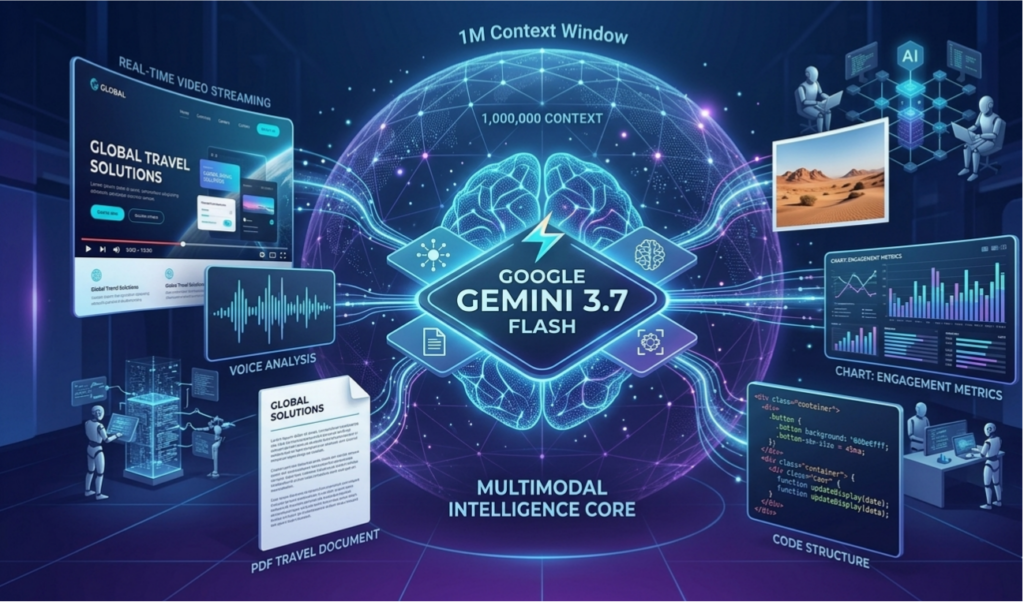
Watch: Gemini 3.7 Flash Multimodal Demonstration
Google DeepMind’s official Gemini 3.7 Flash page includes a robotics demonstration where the model uses multimodal understanding inside a multi-agent graph loop. It also showcases an interactive annual-report workflow that turns a static PDF into an interactive data story.
If readers want the technical details, the official Gemini 3.7 Flash API documentation explains the supported inputs, context limits and tool capabilities.
Why These Three Features Matter Together
Individually, these features are useful.
Together, they become much more powerful.
Imagine an AI system that can:
See a screenshot → understand the design → read the documentation → write the code → use tools → test the result → fix problems → deliver the final application.
That is much closer to an AI worker than a traditional chatbot.
And this is exactly why Google Gemini 3.7 Flash is interesting in 2026.
Its real potential may not come from one spectacular feature.
It comes from combining reasoning, multimodal understanding, coding and agentic execution inside one workflow.
Quick Recap: Features 3, 4 and 5
Strategic Value Matrix
Mapping core architectural innovations to their primary user segments
AI Agents
Handles complex, long-horizon multi-step workflows and dynamic real-time tool execution flawlessly.
Web & App Development
Transforms static UI designs, wireframe screenshots, and rough structural ideas into live functional codebases.
Multimodal Understanding
Native integration that evaluates streams across text, high-res images, audio layers, video reels, and multi-page PDFs.
1M-Token Context
Processes massive data pipelines, hundreds of document pages, and lengthy media archives simultaneously without losing performance.
There are still two more features to uncover.
6. A 1-Million-Token Context Window for Large AI Workflows
One of the biggest practical advantages of Google Gemini 3.7 Flash is its 1-million-token context window.
Google’s official developer documentation confirms that Gemini 3.7 Flash supports up to 1 million input tokens and up to 64K output tokens.
That number sounds impressive, but what does it actually mean?
In simple terms, the model can work with a very large amount of information in a single context.
That can be useful when the task involves:
- Large documents
- Long codebases
- Research papers
- Business reports
- Multiple files
- Long videos
- Complex instructions
- Large collections of reference material
Instead of repeatedly giving the AI small pieces of information, developers can provide a much larger context and ask the model to reason across it.
Why Long Context Matters
Imagine you are a software developer working on a large application.
The project contains:
- Hundreds of files
- Documentation
- Configuration files
- API information
- Error logs
- Existing components
- Tests
A small-context model may struggle to keep all of that information available at once.
A model with a much larger context window can potentially understand more of the project before making a decision.
The same idea applies to research.
A researcher could provide a large collection of papers and ask the AI to identify common themes, contradictions, missing information, or connections between studies.
That does not mean the model will always get everything right.
It means the model has a much larger working space for the information it needs to analyze.
Gemini 3.7 Flash Long-Context Performance
Google’s published evaluations include a long-context test called GDM-MRCR v2.
On the 128K version of that evaluation, Google reports an average score of 97.0% for Gemini 3.7 Flash, compared with 91.8% for Gemini 3.6 Flash.
That suggests the model is getting better at retrieving and connecting information across a large context.
Here’s a simple comparison:
Gemini 3.7 Flash: Core Capabilities
Architectural specifications and system boundaries at a glance
Maximum Input Context
Processes up to 1 million tokens of continuous data stream in a single session layer.
Maximum Output
Generates up to 64K tokens of complex reasoning structures or codebase expansions.
GDM-MRCR v2 Eval
Achieves a 97.0% average accuracy result on 128K long-context recall evaluations.
Thinking Levels
Multimodal Inputs
Native parsing arrays across diverse file streams simultaneously:
The 1-million-token context should not be confused with the amount of information the model will always understand perfectly.
More context does not automatically mean better reasoning.
The model still has to identify which information matters.
That’s why Google’s reported long-context benchmark performance is useful, but real-world results can vary depending on the task.
What Can You Actually Do With 1 Million Tokens?
The possibilities here are genuinely broad, and it’s worth walking through a few to see why.
1. Analyze Large Documents
A company could hand an AI a huge stack of internal documents and ask it to track down specific information buried somewhere inside — without needing to split everything into smaller chunks first.
2. Understand Large Codebases
Developers can feed in a much bigger chunk of an existing project when asking for debugging help or architectural feedback, instead of pasting in isolated snippets and hoping the AI can piece the bigger picture together.
3. Research Long Reports
Researchers can work through large amounts of source material in one go, rather than constantly breaking things up into smaller prompts and losing context between them.
4. Understand Long Videos
Google reports an 85.4% score for Gemini 3.7 Flash on the LVBench long-video understanding evaluation, up from 84.2% for Gemini 3.6 Flash — a solid improvement in how well the model tracks what’s happening across an extended video.
5. Compare Multiple Sources
Instead of just asking an AI to summarize a single document, you can ask it to actually compare information across many documents at once and point out where they agree or contradict each other.
That’s really where a long context window stops being a marketing number and starts becoming a genuinely practical tool for knowledge work.
Example: A Business Research Workflow
Say a company wants to analyze a new market before deciding whether to enter it. It could hand over market reports, competitor information, product documents, customer feedback, internal notes, and pricing information — all at once.
Then it could ask the AI system to identify the biggest opportunities, the biggest risks, and where the gaps are.
The AI still can’t be the final word here — human verification stays essential before any real business decision gets made on top of it. But the sheer amount of information it can chew through in a single workflow could save a genuinely significant amount of time.
That’s a big part of why long-context AI is becoming increasingly import—ant.
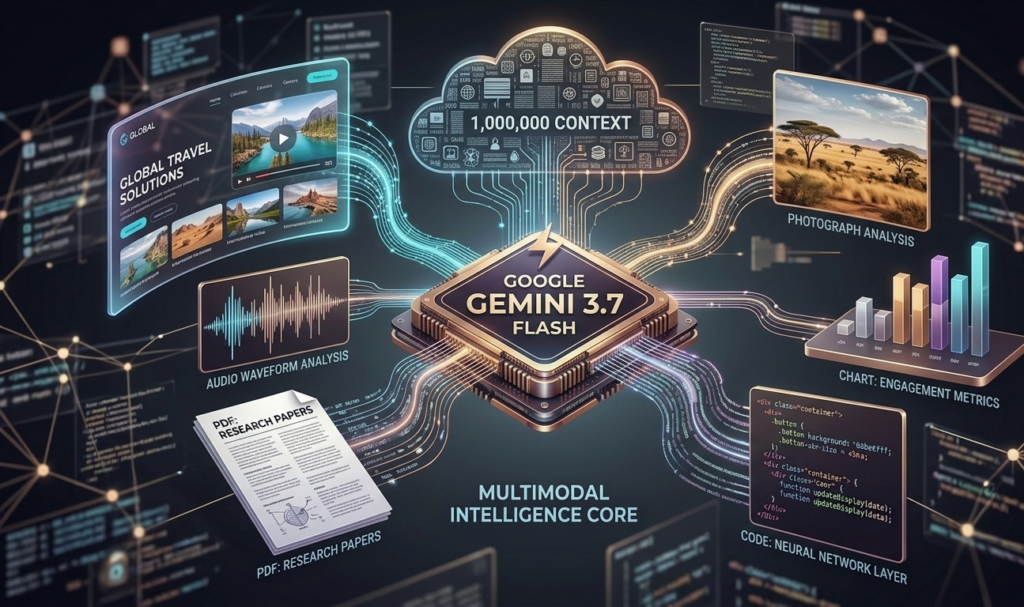
Watch: Gemini 3.7 Flash Long-Context and Multimodal AI
Google’s official Gemini 3.7 Flash demonstrations show how the model can work across multimodal information and complex workflows. The official DeepMind page is a useful visual reference for readers who want to see the model’s capabilities beyond simple chatbot conversations.
Recommended video placement: Put the video here, immediately after the image.
YouTube video:
For readers who want the technical specifications, the official Gemini 3.7 Flash developer documentation explains the context window, thinking controls and supported capabilities.
7. Lower Cost With Strong Performance
Now we reach perhaps the most practical feature of Google Gemini 3.7 Flash:
Its price.
A powerful AI model is useful.
A powerful AI model that developers can afford to run at scale is even more useful.
Google launched Gemini 3.7 Flash with an introductory API price of:
- $0.75 per 1 million input tokens
- $3.75 per 1 million output tokens
That introductory pricing is available through December 31, 2026. Google says the prices will then increase to $1.50 per million input tokens and $7.50 per million output tokens from January 1, 2027.
Gemini 3.7 Flash Pricing
Gemini 3.7 Flash: API Pricing Matrix
Comparing Promotional Launch Discounts vs Upcoming Standard Rates
| Billing Metric | Through Dec. 31, 2026 🔥 Promo Rate | From Jan. 1, 2027 Standard |
|---|---|---|
| Input Stream Per 1 Million Tokens | $0.75 | $1.50 |
| Output Stream Per 1 Million Tokens | $3.75 | $7.50 |
| Context Caching Per 1 Million Tokens | $0.075 | $0.15 |
These prices are for the Gemini API paid tier. Google also lists a free tier for Gemini 3.7 Flash, subject to its applicable limits and conditions.
Why the Price Is Important
Think about a startup building an AI-powered application.
The company may process:
- Thousands of customer requests
- Code-generation tasks
- Document analysis
- Support conversations
- Search requests
- Agent workflows
Even a small difference in the cost per million tokens can become meaningful when usage grows.
This is why AI companies are fighting on two fronts.
They want to build models that are:
Smarter + Faster + Cheaper
Gemini 3.7 Flash is clearly positioned around that combination.
Google says the introductory price is half the original Gemini 3.6 Flash cost per million tokens while offering improvements across software engineering, knowledge work and web development workflows.
Gemini 3.7 Flash vs Gemini 3.6 Flash
So how much better is the new model?
Google’s published evaluation results show improvements across several categories.
Here are some of the most interesting comparisons:
Gemini 3.7 Flash: Telemetry Benchmarks
Comprehensive performance analysis across engineering, context window, and agentic compute
| Benchmark Metric | Gemini 3.7 Flash | Gemini 3.6 Flash |
|---|---|---|
| Production code quality Standard multi-language generation logic | 43.6% ✓ Top | 34.4% |
| Long-horizon software engineering Complex codebase sweeps and repo debugging | 65.3% ✓ Top | 48.6% |
| Web development Design mockups to functional web application Elo | 1588 Elo ✓ Top | 1538 Elo |
| Agentic terminal coding CLI interaction and file system operation execution | 85.8% ✓ Top | 78.0% |
| Enterprise workflow automation Multi-step autonomous business logic tool use | 30.4% ✓ Top | 17.0% |
| PDF comprehension Dense document analysis and data extraction recall | 34.0% ✓ Top | 22.0% |
| Long video understanding Temporal stream analysis over lengthy footage | 85.4% ✓ Top | 84.2% |
| Long-context performance Unified retrieval across extreme input token layers | 97.0% ✓ Top | 91.8% |
| Agentic computer use Direct interface control and system navigation execution | 47.9% ✓ Top | 33.8% |
These are Google’s published benchmark results, not independent universal rankings. Results in real-world applications can vary based on prompts, tools, system design and the specific task.
Still, the pattern is interesting.
Gemini 3.7 Flash isn’t simply being marketed as a faster version of its predecessor.
Google is positioning it as a more capable model for complex workflows.
Google Gemini 3.7 Flash vs Other AI Models
It is also worth looking beyond Google’s own Gemini family.
Google’s published model-card comparison includes several models and shows Gemini 3.7 Flash competing strongly on coding, web development, long-context, multimodal and agentic evaluations.
For example, Google’s published data lists:
Model Efficiency vs Web Performance
Evaluating API procurement cost layers against live development framework benchmarks
| AI Model Platform | Input / 1M Tokens | Output / 1M Tokens | Code Arena Web Dev |
|---|---|---|---|
| Gemini 3.7 Flash 🏆 Top Value | $0.75 * | $3.75 * | 1588 Elo |
| Gemini 3.6 Flash Legacy Value | $0.75 * | $3.75 * | 1538 Elo |
| Claude Sonnet 5 Premium Tier | $2.00 | $10.00 | 1541 Elo |
| GPT-5.6 Terra Enterprise Tier | $2.00 | $12.00 | 1523 Elo |
| Muse Spark 1.2 Mid Tier | $1.25 | $4.25 | 1535 Elo |
* Indicates promotional rate layers active through Dec. 31, 2026.
*Gemini 3.7 Flash’s introductory price applies through December 31, 2026.
This table should be treated as Google’s own published comparison, rather than a neutral independent ranking.
But it does highlight something important:
Gemini 3.7 Flash is trying to compete not only on intelligence, but also on cost efficiency.
Who Should Use Gemini 3.7 Flash?
At this point, you might be wondering whether any of this actually matters for you specifically. Honestly, it depends a lot on what you do.
Developers
If you build software, APIs, or AI agents, this model is particularly worth a look because of its coding, tool-use, and agentic capabilities.
Startups
Startups stand to benefit from the combination of solid capability and pricing that doesn’t eat your runway alive.
Businesses
Companies working with documents, automation, customer workflows, or internal knowledge bases could genuinely put its long-context and multimodal abilities to use.
Researchers
Large documents, PDFs, charts, and long videos can all become part of an AI-assisted research workflow now, instead of getting chopped into fragments first.
Content Creators
The multimodal understanding is useful for analyzing video, images, documents, and other source material without switching tools constantly.
Students
Students can put multimodal AI to work on documents, images, presentations, and dense study material. That said, anything important for a grade or a paper still needs a human double-checking it before it goes in.
What Are the Limitations?
No matter how impressive a model looks on paper, it’s worth resisting the urge to treat it like magic. Gemini 3.7 Flash has real limitations too, and Google’s own model card actually dedicates a full section to intended use, limitations, safety, and evaluation.
1. AI Can Still Make Mistakes
A more capable reasoning model can still confidently hand you something incorrect. Anything that actually matters is worth verifying.
2. Benchmarks Aren’t Real Life
A strong benchmark score doesn’t guarantee it’ll perform flawlessly on your specific project — benchmarks measure something, but not necessarily your exact use case.
3. More Thinking Can Cost More
Turning up the reasoning effort can affect both latency and token usage. That’s really the whole point of adjustable thinking — it exists to let you balance quality, cost, and speed rather than paying maximum cost for every request by default.
4. AI-Generated Code Still Needs a Human Review
Even when the code looks genuinely impressive, developers should still check it for security issues, bugs, performance problems, accessibility, dependency risks, and how it handles data.
5. A Large Context Window Doesn’t Mean Perfect Understanding
A model can technically accept a huge amount of information and still miss or misread something important buried in the middle of it.
6. Pricing Can Change
The current $0.75 input / $3.75 output rates are introductory pricing running through the end of 2026. Anyone planning a long-term application should budget for the higher rates that kick in starting 2027.
Is Gemini 3.7 Flash Better Than Gemini 3.6 Flash?
For a lot of complex workflows, yes. Google’s own evaluation results show real improvements in areas like software engineering, web development, enterprise automation, PDF comprehension, and agentic computer use.
But “better” doesn’t mean it wins at everything. Different models still end up performing better for different use cases depending on what you’re actually trying to do.
The real reason to consider upgrading isn’t just the model number ticking up. It’s the combination underneath it — better reasoning, stronger coding, agentic workflows, multimodal understanding, a much larger context window, and pricing that’s actually competitive. Put together, that’s a meaningfully different tool than what came before it, not just an incremental version bump.
Frequently Asked Questions
What is Google Gemini 3.7 Flash?
Google Gemini 3.7 Flash is Google’s latest Flash model in the Gemini 3 family, designed for complex coding, agentic workflows, multimodal reasoning and knowledge work. Google made the model generally available in August 2026.
Is Gemini 3.7 Flash free?
Google lists a free tier for Gemini 3.7 Flash through the Gemini API, with usage limits. Paid API pricing starts at $0.75 per million input tokens and $3.75 per million output tokens through December 31, 2026.
How much context does Gemini 3.7 Flash support?
Gemini 3.7 Flash supports a 1-million-token input context window and up to 64K output tokens.
Is Gemini 3.7 Flash good for coding?
Yes. Coding and software engineering are among its main target use cases. Google’s published evaluations show substantial gains over Gemini 3.6 Flash on several software-engineering and coding benchmarks.
Can Gemini 3.7 Flash understand images and video?
Yes. Gemini 3.7 Flash supports multimodal inputs including text, images, audio and video, while Google’s API documentation also lists PDF input.
Can Gemini 3.7 Flash build websites?
It is designed for web development and can generate web and application code from design references. Google reports improved design adherence and web-development benchmark performance compared with Gemini 3.6 Flash.
What makes Gemini 3.7 Flash different?
The biggest difference is the combination of reasoning controls, coding ability, agentic workflows, multimodal understanding, large context and relatively low introductory API pricing.
Watch: Official Gemini 3.7 Flash Overview
For readers who want to see Google’s own presentation of the model, add the official developer video here.
Recommended video title:
Introducing Gemini 3.7 Flash — Google for Developers
Final Verdict: Is Google Gemini 3.7 Flash Worth the Hype?
Google Gemini 3.7 Flash fits into a much bigger AI trend shaping up in 2026 — one where models keep getting more capable, more able to work on their own, and genuinely more useful for actual work instead of just party tricks.
After going through all seven features, one thing becomes pretty clear: this isn’t just another routine chatbot bump.
What really stands out is how much comes together in one place here. It can reason through genuinely difficult problems. It can write and debug real code. It can operate inside agentic workflows without constant hand-holding. It can make sense of images, audio, video, and documents all in the same conversation. And it does all of that while working with a context window big enough to hold entire projects at once.
On top of all that, developers currently get access to it at an introductory price of $0.75 per million input tokens and $3.75 per million output tokens — a combination that makes it a genuinely appealing option for developers and businesses building AI-powered products this year.
But there’s a bigger lesson buried in all of this.
The future of AI probably won’t come down to one model winning every single benchmark. The real shift is more likely to come from systems that can reason, reach for tools, understand different kinds of information, and actually see a task through from start to finish. That’s exactly the direction Google seems to be pushing with Gemini 3.7 Flash.
For developers, that could mean faster software development. For businesses, it could mean automation that’s finally affordable at scale. For researchers, it could open the door to working with far more information at once than was practical before. And for everyday users, it nudges AI one step closer to feeling like an actual working partner rather than just a tool you occasionally poke at.
So — could Gemini 3.7 Flash change AI in 2026?
It’s still too early to say it changes everything. But between its capabilities, its benchmark numbers, and its pricing, this is easily one of the more interesting AI releases worth keeping an eye on this year.
Explore More Cutting-Edge AI Insights
If you loved this guide, you will find a goldmine of deeper technical breakdowns, hidden productivity tips, and real-world AI strategy analyses across our portal.