
Google AI watermark is the small symbol you may have already noticed showing up on content made with Google’s AI tools, if you create AI images, videos, or music. Until now, that visible mark was a simple, easy way to signal that a piece of media came from AI. As of today, Google has changed that approach.
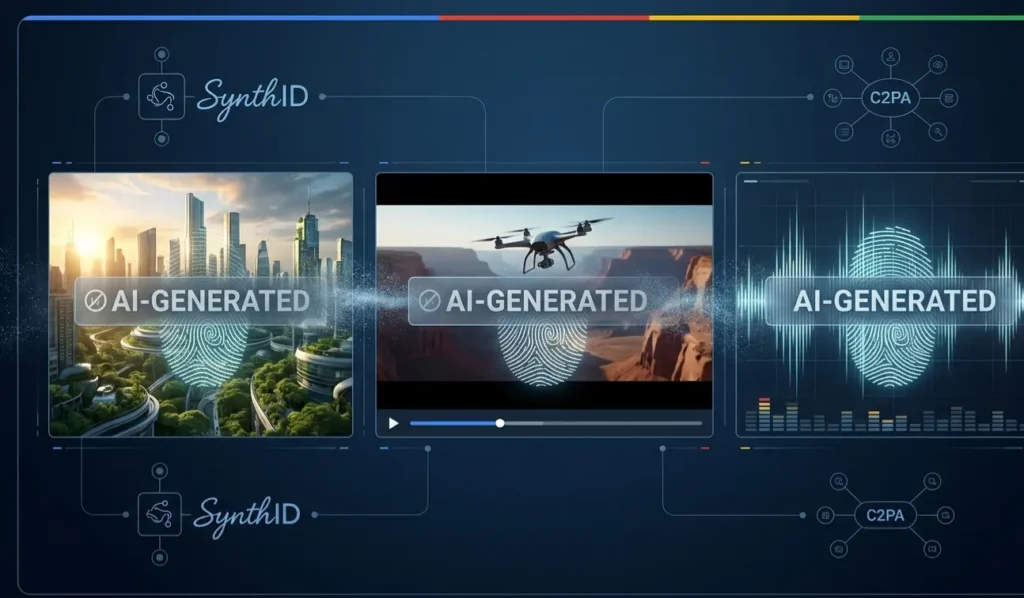
Google’s AI watermark technology is shifting how AI-generated images, videos, and music get identified in 2026. Google has now made the visible watermark optional on supported AI-generated content — but its invisible SynthID watermark and C2PA metadata are still there, staying put underneath the surface.
For readers of AI Tech Pulse, this is more than just another routine Gemini update. Google has rolled out a setting that lets users turn off the visible AI watermark on AI-generated images, videos, and songs. There’s an important catch, though: the invisible SynthID watermark and C2PA metadata remain embedded in the content regardless.
That means Google isn’t simply removing AI identification altogether. Instead, it’s moving toward a system where the obvious visual label can disappear while the deeper verification technology quietly stays behind the scenes.
So what exactly changed, why did Google make this call, and what does it actually mean for creators who work with AI every day? Let’s break it down.
What Exactly Did Google Change?
On August 14, 2026, Google announced that users can now switch off the visible watermark attached to AI-generated media created through its supported AI tools.
The change covers images, videos, and songs, including content generated through Gemini and Google’s Flow video creation tools. The visible watermark can now be toggled off through a new Media Watermark setting.
Before this, the visible watermark gave viewers an immediate, obvious clue that an image or video had been made with AI. Now, Google is handing creators more control over how their finished work actually looks.
But there’s an important distinction worth sitting with here: visible watermark off does not mean AI identification off.
Google says its invisible SynthID watermark reains embedded, while C2PA-related metadata also stays attached to the content.
Visible vs. Invisible AI Watermarks
Watermark Technology Comparison
| Feature | Visible Watermark | Invisible SynthID |
|---|---|---|
| Can people see it? | Yes | No |
| Main purpose | Quick visual identification | Machine-based verification |
| Can user switch it off? | Yes | No |
| Affects appearance? | Yes | Designed not to |
| Used by Google AI? | Yes | Yes |
| Useful for verification? | Basic | More advanced |
This distinction is going to become increasingly important as AI-generated media becomes harder to distinguish from human-created work.
Why Is Google Making AI Watermarks Optional?
At first glance, this decision might seem a little strange. If visible watermarks help people recognize AI-generated content, why let users remove them at all?
The answer really comes down to creative control.
A visible watermark can be genuinely useful for transparency, sure, but it can also mess with the final look of an image, video, or piece of creative work. A designer putting together an advertisement, a filmmaker producing a concept scene, or a creator prepping social media content might not want a small symbol permanently sitting on top of their finished piece.
Google seems to be trying to balance both sides of this at once. What the company is essentially saying is: creators should have more freedom over how their work actually looks, while AI-generated content should still have some way of being identified underneath.
That’s exactly why the invisible layer matters so much here. According to Google, the visible watermark can be switched off while SynthID and C2PA metadata keep quietly providing transparency and provenance information behind the scenes.
What Is SynthID, Exactly?
This is where Google’s whole system gets a lot more interesting.
SynthID is Google’s technology for embedding an invisible digital watermark directly into AI-generated content. Unlike a traditional watermark that shows up as text, a logo, or a visible symbol, SynthID is built to be completely imperceptible to the human eye or ear.
Google has developed SynthID across multiple types of generative media, covering images, video, audio, and even text.
The official Google DeepMind video above is worth adding to the article because it gives readers a simple visual explanation of how invisible AI watermarking works.
How Does an Invisible Watermark Work?
The basic idea is surprisingly clever.
Instead of placing an obvious logo on an image, the technology embeds a signal into the generated content itself.
For example, with AI-generated images, the watermark can be incorporated into the visual information in a way that humans normally cannot notice.
With video, Google’s technology can work across video frames, while audio can also contain an imperceptible signal. Google has explained that SynthID is designed to remain useful even when generated media goes through common changes such as compression or resizing, although detection is not guaranteed after every possible modification.
This is important because a visible watermark is easy to understand but also easy to crop, cover, or remove.
An invisible watermark takes a completely different approach.
Google AI Watermark vs. C2PA: What’s the Difference?
Another term you’ll see frequently in the AI transparency conversation is C2PA.
C2PA stands for the Coalition for Content Provenance and Authenticity. It is an industry standard designed to provide information about where digital content came from and how it was created or edited.
Think of it like a digital history card attached to a piece of media.
Google describes Content Credentials as something similar to a digital passport that can provide information about a piece of content’s origin and history.
So, SynthID and C2PA aren’t exactly the same thing.
AI Content Provenance & Ecosystem
| Technology | What it does | Visible? |
|---|---|---|
| Visible AI watermark | Gives viewers an obvious AI label | Yes |
| SynthID | Embeds an invisible signal into AI-generated media | No |
| C2PA | Records provenance and content history | Usually no |
| Content verification | Helps users investigate whether AI was involved | No |
Together, these technologies create multiple layers of AI transparency.
And that’s the bigger story behind Google’s latest update.
Can You Still Detect AI Content If the Visible Watermark Is Gone?
Yes — at least for supported Google AI content. This is probably the single most important point to actually understand here.
Turning off the visible watermark doesn’t automatically make a Gemini-generated image impossible to identify. Google says the invisible SynthID watermark stays put, and its verification tools can still be used to check supported AI-generated images, videos, and audio.
For example, Google’s Gemini verification feature lets users upload a piece of media and ask something like “was this created with Google AI?” Gemini can then check for the relevant signals underneath.
Google’s own support documentation explains that if SynthID is detected, it means some or all of the content was created or edited using Google’s AI models. But failing to detect SynthID doesn’t prove something is completely human-made either — the content could easily have been created with a different AI system entirely. That’s a pretty crucial limitation to keep in mind.
A Simple Example
Imagine you come across an impressive image on social media. There’s no visible AI watermark anywhere on it. You might naturally assume, “this must be a real photograph.”
But that conclusion could easily be wrong. The image could have been generated using Gemini, with the visible mark simply switched off, while the invisible SynthID signal is still sitting there underneath. That’s exactly why the future of AI verification is moving well beyond just glancing at an image for a watermark.
What This Means for AI Creators
For creators, Google’s decision here is actually a pretty big deal.
AI image and video generation has moved well past simple experiments at this point. People now use generative AI for marketing, YouTube thumbnails, advertisements, concept art, product visuals, social media content, and a whole lot more. A visible watermark can sometimes make otherwise professional content look unfinished or amateur.
Google’s new approach gives creators more flexibility while still keeping an invisible identification layer running in the background.
The Biggest Benefits
Cleaner creative work. Creators can produce AI-generated visuals without a visible symbol sitting over part of the image or video.
More professional presentation. Businesses and designers may well prefer clean visuals without an obvious AI marker stamped on them.
AI transparency doesn’t completely vanish. The invisible SynthID layer stays available for supported Google-generated content, even with the visible mark gone.
Better separation between appearance and verification. The person actually viewing the content doesn’t need to see a watermark, while verification systems can still dig into its origin whenever needed.
But There’s Also a Serious Concern Here
This change isn’t perfect, and it’s worth being upfront about that.
The biggest concern is simple: people can no longer rely on their eyes alone. When visible watermarks disappear, someone scrolling through social media may have no immediate clue that an image was generated by AI at all.
That matters more than it might seem, because AI-generated media keeps getting more realistic by the month. A fake photograph, a fabricated video, or a synthetic audio clip can spread rapidly online before anyone even thinks to check where it actually came from.
Google’s own documentation admits that SynthID isn’t a perfect solution either. Its verification system is designed to help identify Google AI content specifically, but it can’t prove that every piece of media without a SynthID signal is human-made. That leaves a genuinely new challenge for everyone online to navigate.
The Bigger Shift: From Visible Labels to Invisible Verification
The most interesting part of this whole Google AI watermark update isn’t really the removal of the visible symbol itself. It’s the shift in philosophy underneath it.
For years, the easiest way to label AI content was simply slapping a visible mark on it. Now the industry is increasingly exploring something different: let the content look completely normal, but make its origin verifiable if anyone actually goes looking.
Google has already been expanding its tools around AI content verification across Gemini, Search, Chrome, Pixel, and a handful of other products. That suggests invisible provenance could become a much bigger part of how the internet identifies synthetic media going forward — and we’re really only at the beginning of that shift.
How Google AI Watermark Technology Actually Works
Earlier, we looked at Google’s decision to let users remove the visible watermark from AI-generated images, videos, and music. But the more interesting question is really what happens after that visible mark disappears.
This is exactly where SynthID and C2PA come into play.
The idea itself is simple: AI-generated content doesn’t necessarily need to carry an obvious label on screen. Instead, information about its origin can exist quietly underneath the surface. That approach could matter more and more as AI-generated media becomes harder to tell apart from real photographs, recordings, and videos.
How SynthID Identifies AI-Generated Content
SynthID is Google’s invisible watermarking system, developed by Google DeepMind. It’s designed to embed a digital signal into AI-generated content without making that signal obvious to anyone viewing or listening to it.
Google has expanded SynthID across several types of generative media, including images, video, audio, and text.
For images, the watermark gets embedded during the actual generation process, rather than being tacked on afterward like a traditional logo would be. For video, the system can work across the generated frames themselves. For audio, the signal is embedded directly into the sound. In every case, the result is built to stay invisible during normal, everyday use.
SynthID vs. Traditional Watermarks
Traditional vs. Next-Gen Watermarking
| Feature | Traditional Watermark | Google SynthID |
|---|---|---|
| Appearance | Visible | Invisible |
| Main purpose | Show ownership/source | Help identify AI origin |
| Affects design | Often yes | Designed not to |
| Easy to notice | Yes | No |
| Designed for AI content | Not necessarily | Yes |
| Verification | Visual inspection | Technology-assisted detection |
This difference is why Google’s latest update is more significant than simply removing a logo.
The visible label can disappear, but the underlying identification signal can remain.
Can Someone Simply Edit the AI Image and Remove SynthID?
This is where things become more complicated.
No watermarking system should be treated as an unstoppable digital fingerprint.
People can crop images, resize them, compress files, change formats, edit videos, add filters, or manipulate audio. These changes can affect embedded signals.
Google says SynthID is designed to be robust against many common modifications, including cropping, filters and compression. However, Google also makes clear that detection is not guaranteed in every situation.
That distinction is important.
Think of SynthID Like This:
Imagine you have an AI-generated image.
You:
- Download the image.
- Crop the edges.
- Resize it.
- Upload it to social media.
- The platform compresses it.
- Someone downloads it again.
The visible watermark may already be gone.
But Google’s system may still be able to detect the SynthID signal.
That is one of the major advantages of invisible watermarking.
However, detection should not be confused with certainty.
If SynthID isn’t detected, that doesn’t automatically mean the image was created by a human.
It could simply mean the image came from another AI system.
What Happens When AI Content Is Screenshot?
This is one of the questions creators are likely to ask.
Suppose someone generates an image with Google AI, removes the visible watermark, and then takes a screenshot.
Does the screenshot still contain the original AI watermark?
The answer isn’t as simple as yes or no.
A screenshot changes the digital representation of an image. Depending on the circumstances, the original embedded signal may become weaker or harder to detect.
This is why AI watermarking isn’t intended to function as an absolute guarantee that every copy of content will always be identifiable.
Instead, technologies such as SynthID are part of a broader content provenance and verification system.
That system can include invisible watermarks, metadata, Content Credentials and other signals.
What Is C2PA?
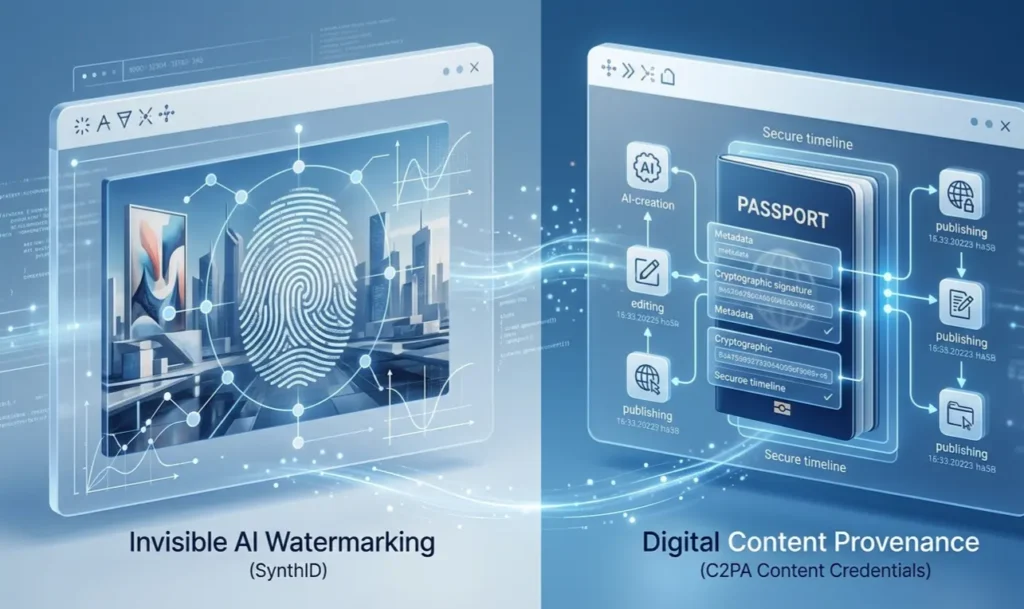
If SynthID is Google’s invisible AI signal, C2PA is a different piece of the puzzle.
C2PA stands for Coalition for Content Provenance and Authenticity.
It is an open technical standard designed to help establish information about the origin and history of digital content.
In simple terms, imagine that an image has a digital record attached to it.
That record can potentially tell you things such as:
- Where the content came from
- What tool created it
- Whether it was edited
- What changes were made
- Which organization or application signed the content
This information is often presented through Content Credentials.
The official C2PA project describes the technology as a way to establish provenance and authenticity for digital content.
SynthID and C2PA Work Differently
AI Detection & Tracking Technologies
| Technology | Main Job | Example |
|---|---|---|
| SynthID | Invisible watermark | Helps identify Google AI-generated content |
| C2PA | Provenance information | Shows information about content origin/history |
| Visible watermark | Human-facing label | Lets viewers immediately see an AI marker |
| Metadata | Additional digital information | Can contain creation or editing details |
This is why Google’s latest change shouldn’t be interpreted as:
“Google removed AI identification.”
A more accurate interpretation is:
“Google removed the requirement for an obvious visual AI label while retaining less visible identification and provenance technologies.”
That’s a much bigger story.
Why C2PA Could Become Extremely Important
The internet is entering a period where simply looking at an image may no longer be enough to actually understand where it came from.
Consider a hypothetical example. A photo shows up online of a famous person doing something controversial. The image looks completely real. There’s no visible AI watermark anywhere in sight.
Instead of immediately believing it or dismissing it outright, a future content verification system could examine its provenance information instead. If the image carries valid Content Credentials, users could potentially find out whether it was captured by an actual camera, generated by AI, edited with software, or modified sometime after it was originally created.
That said, this doesn’t mean C2PA will magically tell you whether every image is true or false — provenance isn’t the same thing as truth. An authentic camera photograph can still show something genuinely misleading. Likewise, an AI-generated image can be clearly disclosed as AI-generated without being harmful in any way. The technology is really about giving users more information about where content came from and how it’s been handled along the way, not passing judgment on whether it’s honest.
Google’s AI Watermark Strategy Is Getting More Advanced
Google’s overall approach is starting to look like a genuinely layered system. Instead of relying on one obvious watermark to do all the work, several different technologies can now work together at once.
The Three-Layer Approach
Layer 1 — Visible identification. The user may see a watermark directly on the content itself, when it’s turned on.
Layer 2 — Invisible identification. SynthID provides an embedded signal that people normally can’t see or hear at all.
Layer 3 — Provenance. C2PA and Content Credentials can provide…ide additional information about the origin and editing history of digital media.
Multi-Layered Verification Architecture
| Layer | Visible to User? | Purpose |
|---|---|---|
| Visible watermark | ✅ Yes | Immediate disclosure |
| SynthID | ❌ No | AI-content identification |
| C2PA credentials | Usually ❌ | Provenance and history |
This layered approach could become one of the most important developments in AI-generated media.
What Does This Mean for YouTube Creators?
This change isn’t only relevant to people creating images.
It could also matter to YouTube creators.
AI-generated video is becoming a normal part of content production. Creators can use AI for:
- Backgrounds
- B-roll
- Visual effects
- Character animation
- Concept scenes
- Voice generation
- Music
- Entire video sequences
As AI-generated video becomes more realistic, platforms need better ways to understand how content was created.
Google’s invisible watermarking technology could potentially become part of that wider ecosystem.
For creators, this could eventually mean that transparency doesn’t have to ruin the visual quality of a video.
Instead of placing a giant “AI GENERATED” label across the screen, the content could carry invisible signals and provenance information.
That would be a much cleaner solution.
🎥 Recommended YouTube Video
Google’s SynthID: A Guide With Examples
Can Google AI Watermarks Be Completely Removed?
This is probably going to become one of the most searched questions around this update.
The short answer is:
There is no simple guarantee that an AI watermark will survive every possible transformation.
Google has designed SynthID to be resistant to various common modifications, but that doesn’t mean it is impossible for detection to fail.
And this is an important distinction for anyone writing about AI detection.
A watermark isn’t the same as DRM.
It isn’t a digital lock preventing people from editing an image.
It is primarily an identification mechanism.
If someone intentionally modifies content in ways that damage the embedded signal, detection may become more difficult.
That’s why Google is also relying on broader provenance technologies rather than treating SynthID as a magic solution.
The Bigger Problem: AI Detection Is Becoming Harder
Here’s where things get interesting.
AI generation is improving rapidly.
At the same time:
AI detection is also becoming more sophisticated.
It’s almost like an arms race.
AI models generate increasingly realistic content.
Detection systems try to identify that content.
Creators modify or edit AI-generated media.
Detection systems adapt again.
This cycle is likely to continue throughout 2026 and beyond.
And Google isn’t the only company thinking about this problem.
OpenAI, Adobe, Microsoft and other technology companies have also explored different approaches to AI-generated content transparency and provenance.
The industry appears to be moving toward a future where content history becomes more important than simply looking for a visible watermark.
Why Google’s Latest Change Matters
At first, Google’s announcement might sound like a small user-interface update.
It’s not.
The ability to remove a visible watermark represents a broader change in how AI-generated media could be presented.
Creators want freedom.
Platforms want transparency.
Users want trustworthy information.
AI companies need to balance all three.
Google’s solution is essentially:
Keep the visible label optional, but keep deeper identification technology active.
Whether that approach becomes the industry standard remains to be seen.
But one thing is already clear.
The future of AI transparency probably won’t depend on a little logo sitting in the corner of an image.
It will depend on technology operating underneath the content.
What Creators Should Know Right Now
If you’re using Google AI tools in 2026, remember these five points:
- The visible watermark may be removable on supported Google AI-generated media.
- SynthID can remain embedded even when the visible mark is turned off.
- C2PA provides a separate provenance layer for supported content.
- No detection system is perfect.
- No visible watermark doesn’t automatically mean human-created content.
That final point could become especially important as AI-generated media spreads across social platforms.
What Google AI Watermark Changes Mean for Creators in 2026
The biggest takeaway from Google’s latest Google AI watermark update is simple: AI-generated content is moving away from obvious labels and toward invisible verification.
On August 14, 2026, Google made visible watermarks optional for supported AI-generated images, videos, and music. But the invisible SynthID watermark and C2PA metadata remain, meaning the content can still carry information that helps with AI identification and provenance.
For everyday users, this may look like a small settings change.
For creators, bloggers, YouTubers, designers, journalists, and businesses, it could be a much bigger shift.
What Does This Mean for AI Creators?
Until recently, a visible watermark gave viewers an instant clue.
You could look at an AI-generated image and see a small symbol in the corner.
Now that symbol can be removed on supported Google AI creations.
That means creators get more control over presentation, but viewers may need to rely more on verification tools instead of simply looking at an image.
Google says the goal is to balance creative control and safety while keeping invisible SynthID and C2PA information in place.
The New Situation
The Watermarking Evolution
| Before | Now |
|---|---|
| Visible AI watermark was obvious | Visible watermark can be turned off |
| Viewers could identify AI content visually | Viewers may need verification |
| AI label affected the visual design | Cleaner final media |
| SynthID provided invisible identification | SynthID remains |
| C2PA provides provenance where supported | C2PA remains part of the system |
This is a major change in how people may interact with AI-generated media.
Is Removing the Visible Watermark a Good Thing?
There are arguments on both sides.
👍 Why Creators May Like It
A visible watermark can sometimes make professional content look unfinished.
Imagine a filmmaker generating a cinematic scene for a concept trailer.
Or a designer creating an AI-generated product image for a presentation.
Or a blogger creating a clean hero image for an article.
Having a visible symbol over every piece of content isn’t always desirable.
The new option gives creators more control over the final appearance.
👎 Why Some People May Dislike It
The problem is transparency.
A person scrolling through social media may see an incredibly realistic image and have no obvious visual clue that AI was involved.
That could make misinformation and manipulated media harder for ordinary users to recognize.
Google’s own broader transparency strategy recognizes that people need better ways to understand how digital content was created and edited.
So the debate isn’t really:
“Should AI have watermarks?”
It’s becoming:
“How should AI content be identified without damaging the creator’s work?”
Will AI Watermarks Become the New Standard?
I think the answer is increasingly likely to be yes — but invisible watermarking and provenance will probably matter more than visible logos.
Google has already been working with companies and organizations to expand AI content transparency.
At Google I/O 2026, Google said SynthID had already been used to watermark more than 100 billion images and videos and 60,000 years of audio, while Content Credentials were also being expanded across its products.
Google has also said it is working with partners including OpenAI, NVIDIA, ElevenLabs, Apple and others around interoperable watermarking approaches.
That suggests the industry is moving toward a future where AI provenance becomes a normal part of digital media.
Where the Industry Could Be Heading
AI Verification Roadmap & Stages
| Stage | Likely Approach / Goal |
|---|---|
| Earlier AI era | Visible AI labels |
| Current transition | Visible + invisible watermarks |
| Near future | Invisible watermarks + Content Credentials |
| Longer term | Cross-platform verification |
| Goal | Easier identification of AI-generated media |
The important word here is interoperability.
If every AI company creates a completely different system, users will have difficulty checking content.
If multiple companies adopt compatible standards, verification becomes much more useful.
What About YouTube and Social Media?
This is where things get particularly interesting.
AI-generated videos are exploding across social platforms.
Creators can now generate:
- Entire scenes
- AI characters
- Voiceovers
- Music
- Background footage
- Product demonstrations
- Short-form videos
- Animated explainers
The technology is becoming accessible to almost everyone.
But that creates a problem for platforms.
How do you distinguish:
real footage → AI footage → AI-assisted footage → heavily edited footage?
A visible watermark isn’t always enough.
That’s why invisible signals and provenance information could eventually become much more important.
Google already allows users to verify supported AI-generated videos in Gemini by uploading a video and asking whether it was generated or edited with Google AI. Gemini can check for SynthID signals across the audio and visual tracks.
That is a much more powerful idea than simply putting a logo on the video.
🎥 Watch Video: SynthID for AI-Generated Text
SynthID – Watermarking and identifying AI-generated text
What Should Bloggers Do With AI-Generated Images?
This is particularly relevant for websites like AI Tech Pulse.
If you use AI-generated featured images, illustrations, thumbnails, or graphics, don’t assume that removing a visible watermark means the content has become “undetectable.”
That’s not how the technology works.
Instead, creators should think about transparency and responsible publishing.
For example, if you’re using AI to create an illustration for an article, you can make it clear in the article’s image description or caption when appropriate.
For professional publishers, keeping track of where images came from is also becoming increasingly important.
A Simple Creator Workflow
Step-by-Step AI Content Workflow
| Step | What to Do |
|---|---|
| 1 | Generate the image/video with your AI tool |
| 2 | Check whether AI provenance is embedded |
| 3 | Keep the original file |
| 4 | Don’t falsely present synthetic media as real |
| 5 | Add disclosure when context requires it |
| 6 | Keep source information for future reference |
This isn’t about being afraid of AI.
It’s about using it responsibly.
Does SynthID Prove Something Is Real?
No.
This is one of the most important points in the entire article.
SynthID can help identify content generated or altered by supported Google AI systems.
But that doesn’t mean:
“SynthID detected = real.”
And:
“SynthID not detected = human-made.”
Those are completely different things.
Google itself describes SynthID as an important building block rather than a perfect solution.
For example, if you upload an image created with another company’s AI system, Google’s SynthID system may not find a Google watermark.
That doesn’t make the image human-created.
It could simply mean that another AI model generated it.
This Is the Golden Rule
No AI watermark does not automatically mean no AI.
That single sentence will become increasingly important as AI-generated media becomes normal.
What Happens to Copyright and Ownership?
Watermarks don’t solve copyright questions.
They are primarily about identification and provenance.
An AI watermark can potentially help establish that content came from an AI system, but it doesn’t automatically answer:
- Who owns the final work?
- Can the image be copyrighted?
- Was copyrighted material used during generation?
- Who owns an AI-generated song?
- Can a creator commercially use it?
- What happens if someone modifies it?
Those are separate legal and policy questions.
So creators shouldn’t assume that a SynthID watermark gives them ownership rights.
It doesn’t.
Google vs. Other AI Companies
Google isn’t working on AI transparency in isolation.
Other major AI companies are also developing ways to identify or label AI-generated content.
For example, Anthropic recently announced plans for invisible watermarks and metadata for Claude-generated content, including C2PA for images.
This is interesting because it shows that the industry is increasingly moving toward machine-readable identification rather than relying only on visible labels.
AI Transparency Approaches
Industry Implementation Tracker
| Company / Technology | Approach |
|---|---|
| SynthID + C2PA | |
| Anthropic | Invisible watermarking + C2PA |
| OpenAI | Content provenance and watermarking research/standards |
| Adobe | Content Credentials |
| Industry standard | C2PA |
The exact implementation differs between companies, but the direction is similar:
AI-generated content should carry information about its origin.
The Biggest Challenge: Deepfakes
The watermark debate becomes even more serious when we talk about deepfakes.
A funny AI image isn’t necessarily a major problem.
But imagine a fake video showing a politician, celebrity, company executive, or ordinary person apparently saying something they never said.
Without context, viewers may believe it.
Google has highlighted how difficult high-quality deepfakes can be for humans to identify and has been expanding verification tools across Gemini, Search and Chrome.
This is why invisible verification could become increasingly important.
Instead of asking:
“Can I tell this is AI by looking at it?”
People may eventually ask:
“Can I verify where this content came from?”
That’s a much better question.
What Could AI Watermarks Look Like in 2027 and Beyond?
The future could be very different from today’s visible AI labels.
Imagine opening an image online.
You don’t see a giant AI symbol.
Instead, your browser shows a small Content Credentials indicator.
You click it.
A panel appears:
Created with AI
Generated by: Google AI
Edited: Yes
Original source: Available
That kind of system could make the internet much easier to navigate in an AI-heavy world.
Google is already expanding Content Credentials verification across its products, including Search and Chrome.
Of course, this future isn’t guaranteed.
Technology adoption, platform support, privacy concerns and regulations will all influence how quickly it happens.

What Does Google’s 2026 Change Really Mean?
After looking at the technology, the answer is actually quite straightforward.
Google isn’t abandoning AI watermarks.
It’s changing how they work.
The visible part becomes optional.
The invisible part stays.
And provenance information becomes increasingly important.
That is a reasonable compromise between creative freedom and transparency.
For creators, it means cleaner-looking content.
For viewers, it means that visual inspection alone becomes less reliable.
For technology companies, it means they need better verification systems.
And for the internet as a whole, it means we’re entering a new era where knowing where content came from may become almost as important as seeing the content itself.
Frequently Asked Questions
Can I remove the Google AI watermark?
Google now allows users to turn off the visible watermark on supported AI-generated images, videos and music. However, invisible SynthID and C2PA information can remain.
Does removing the visible watermark remove SynthID?
No. Google’s current announcement specifically says that the invisible SynthID watermark remains even when the visible watermark is disabled.
What is SynthID used for?
SynthID is Google’s technology for embedding invisible digital watermarks into AI-generated content so that supported content can be identified later. Google says it works with images, video, audio and text.
What is C2PA?
C2PA is an industry standard for recording information about the provenance and history of digital content, including how it was created or modified.
Can SynthID detect every AI image?
No. SynthID is designed specifically to identify content carrying Google’s SynthID watermark. Content generated by other AI systems may not contain that signal. Google also describes SynthID as not being a foolproof solution.
Does no watermark mean an image is real?
Absolutely not. The absence of a visible watermark—or even the absence of a SynthID signal—doesn’t prove that content was created by a human.
Final Verdict: The Watermark Is Disappearing, But AI Identification Isn’t
Google’s latest AI watermark update might initially look like a simple little feature that just lets users clean up their AI-generated images and videos.
But the bigger story here is a lot more interesting than that.
The internet is slowly shifting away from visible AI labels and toward invisible identification and digital provenance instead. Creators want clean-looking content. Platforms want genuine transparency. Users want to actually know what they’re looking at. SynthID and C2PA are essentially Google’s attempt to bring those three, often competing, needs a little closer together.
And as AI-generated images, videos, and music keep getting harder and harder to tell apart from human-created media, technologies like these could well become a completely normal part of the internet.
So yes, the visible watermark may well disappear. But the digital fingerprint sitting underneath it is only becoming more important than ever.
Useful External Resources
For readers who want to explore the technology further:
- Google DeepMind — SynthID — Google’s official explanation of how SynthID works.
- Google: Identifying AI-generated media online — Google’s broader content verification strategy.
- C2PA official website — Learn about the industry standard for digital content provenance.
- Google DeepMind: SynthID technology — Technical background on invisible watermarking.
Supercharge Your Tech Knowledge with AI Tech Pulse!
Struggling to keep up with the fast-moving world of artificial intelligence? We have got you covered! Explore our expert guides, tools, and tutorials designed to solve your tech problems instantly.
Don’t Miss Our Latest Solved Guides:
Get in Touch
✉️ hello@aitechpulse7.com