
The conversation around AI agents vs chatbots has become one of the biggest topics in tech this year — and for good reason, because the two work in fundamentally different ways, even though people often use the terms interchangeably.
Just a couple of years ago, most people used AI for pretty basic stuff — asking questions, drafting an email, generating an image, or summarizing a long document. Now AI is starting to do something bigger: it can actually take action on its own.
That’s the whole idea behind AI agents.
If you’ve been paying attention to AI news in 2026, you’ve probably run into terms like “AI agents,” “agentic AI,” and “AI chatbots” more times than you can count. They get thrown around like they mean the same thing, but they really don’t.
So here’s the real question: what actually separates an AI agent from a chatbot?
Think of it this way — a chatbot is built to talk with you and respond to whatever you ask. An AI agent takes that a step further. It can plan out a task, pull in different tools, make its own decisions along the way, and work through multiple steps to actually finish something.
For anyone following AI Tech Pulse, this distinction matters more than it might seem. The AI industry is shifting from tools that just generate answers to tools that can actually get work done.
What Is an AI Chatbot?
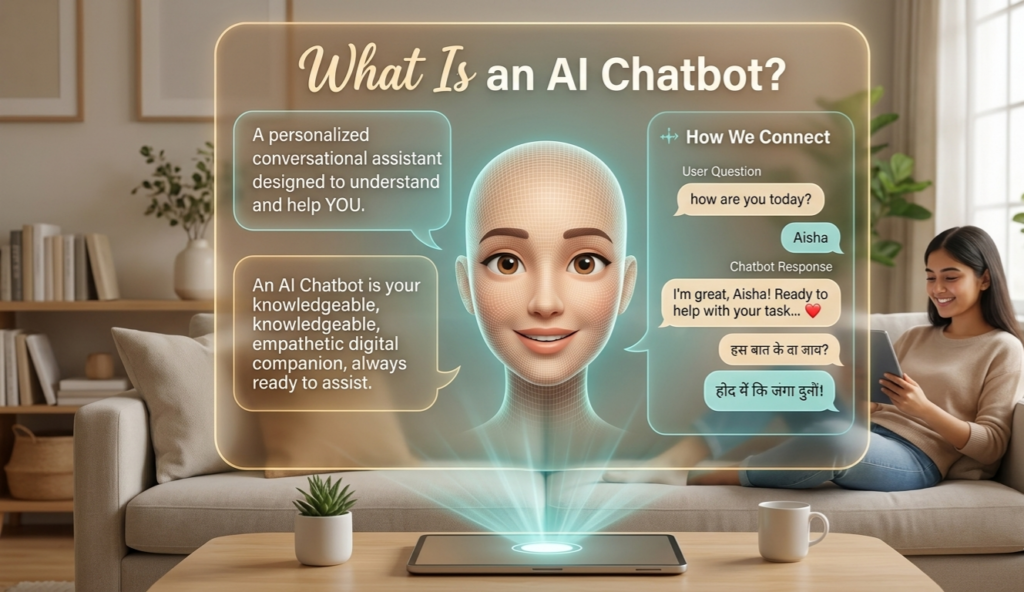
An AI chatbot is software you talk to in plain language. You type something, it responds.
Say you ask it:
“Write me a short email asking my manager for Friday off.”
It’ll write that email. Then you follow up with:
“Make it sound more professional.”
It rewrites it. You push a little further:
“Translate it into French.”
It does that too, no problem.
That’s genuinely useful — but here’s the catch. The chatbot is really just reacting to whatever you say in the moment. You give it one instruction, it handles that one thing, and it hands the result back to you. Tools like ChatGPT, Claude, Gemini, and other conversational AI assistants have made this back-and-forth feel completely normal for millions of people by now.
But here’s where it gets interesting. Picture handing AI a much bigger job. Instead of asking:
“Give me five ideas for a travel itinerary.”
You say:
“Plan my entire three-day trip. Look into hotels, compare prices, check out activities, build a full schedule, and put it all together in one document for me.”
That’s a different kind of request entirely — and it’s exactly where the idea of an AI agent starts to make a lot more sense.
What Is an AI Agent?
An AI agent is designed to do more than simply respond.
It can work toward a goal by deciding what steps are needed, using available tools, and taking actions.
OpenAI describes agents as applications that can plan, call tools, work with other specialists, and maintain enough state to complete multi-step tasks.
AI Agents Explained: How They Work and Why They Matter
Think about it like this.
A chatbot is closer to an AI assistant you talk to.
An agent is closer to an AI worker you give a task to.
For example, imagine telling an AI agent:
“Find the best laptop under $1,000 for video editing.”
A simple chatbot might give you a list of laptops based on its knowledge.
An agent could potentially:
- Search current products.
- Collect specifications.
- Compare prices.
- Check reviews.
- Remove products that do not meet your requirements.
- Create a comparison table.
- Recommend the best option.
The exact capabilities depend on the system and the tools connected to it, but this example shows the key difference.
The agent is not only generating text.
It is working through a process.
AI Agents vs Chatbots: The Simplest Explanation
If you take away just one thing from this whole article, let it be this:
Chatbots mostly respond. AI agents can reason through a problem, make a plan, pull in tools, and actually act on your behalf to get something done.
That doesn’t mean every chatbot is basic, or that every agent is running completely on its own. Truth is, most modern AI systems are starting to blend both experiences together. A chatbot can start acting a lot like an agent the moment you connect it to things like web search, code execution, a database, other software, or even control over your computer. That’s exactly why the line between “chatbot” and “agent” can feel blurry in 2026 — a lot of tools now live somewhere in between.
A Simple Real-Life Example
Say you run a small online business, and last month your sales took an unexpected dip. You want to know why.
Ask a regular chatbot:
“Why might my online sales have dropped?”
You’ll get a solid list of possibilities back — maybe your website traffic slowed down, prices went up, your conversion rate slipped, it’s just a seasonal dip, competitors got more aggressive, or something changed in your ad spend.
That’s a decent starting point. It gives you a few directions to look into.
Now picture an AI agent that’s actually connected to your business’s analytics tools. This time you ask:
“Find out why sales dropped last month and prepare a report.”
Rather than guessing at general reasons, the agent could genuinely go check. It could pull your website traffic and compare it against previous months, look at how your conversion rates moved, dig into which products underperformed, review how your ads actually did, spot anything that looks off, and then pull all of that into one clear summary — a finished report, not just a list of guesses.
That’s the real difference. One system tells you what might be going on. The other goes and looks at your actual numbers, connects the dots, and hands you an answer built on real data.
And that’s really the promise behind agentic AI — it doesn’t just talk about the problem, it goes and works the problem.
Why AI Agents Are Trending in 2026
The shift toward AI agents is not just another marketing phrase.
Major AI companies are building tools and platforms around agentic workflows.
OpenAI, for example, provides an Agents SDK and tools for building applications that can coordinate tasks and use tools. Its current agent-focused products are designed around systems that can reason, take actions, and complete workflows.
The broader industry is also moving in this direction.
MIT Sloan describes agentic AI as systems that can perceive, reason, and act with some level of autonomy rather than simply answering questions.
This is why 2026 feels different from the early chatbot boom.
The conversation is slowly changing from:
“What can AI tell me?”
to:
“What can AI do for me?”
That is a much bigger question.
The Key Differences Between AI Agents and Chatbots
Let’s make the difference easier to understand.
📊 Quick Comparison: AI Chatbot vs AI Agent
| Feature | 💬 AI Chatbot | 🤖 AI Agent |
|---|---|---|
| Main purpose | Conversation and responses | Completing goals and tasks |
| Typical behavior | Responds to prompts | Plans and executes steps |
| Tool use | May have limited tools | Often designed around tool use |
| Decision-making | Mostly within the response | Can make decisions during a workflow |
| Multi-step tasks | Usually user-guided | Can handle multiple steps |
| Automation | Limited to moderate | Often much higher |
| Human involvement | Usually frequent | Can be reduced depending on the task |
| Example | “Answer a question” | “Research, compare, decide, and report” |
This table does not mean that every chatbot has limited capabilities.
Modern chatbots can browse the web, analyze files, create images, write code, and use other tools.
The important point is how the system is designed to complete a task.
An agent is generally built around the idea of taking a goal and working through the steps required to achieve it.
Chatbots Are Not Going Away
It’d be a mistake to think AI agents are here to replace chatbots entirely. They’re not — chatbots are still genuinely useful, and honestly, for a huge chunk of what people actually need day to day, they’re the right tool.
If all you want is a quick answer, a bit of back-and-forth, an explanation, some brainstorming, or help writing something, a chatbot covers you completely. Something like:
“Explain quantum computing like I’m 12.”
There’s no reason to bring in some complicated autonomous agent for a question like that. A chatbot answers it on the spot, no extra setup, no waiting around.
Agents start earning their keep when a task gets longer, messier, repetitive, or requires actually doing something rather than just explaining it.
Here’s the simplest way to think about it:
Chatbot = conversation. Agent = workflow.
Both have a real place going forward — this isn’t really an either/or situation.
Where Things Get Interesting
Here’s what makes this whole space genuinely interesting right now: these two categories are starting to blend into each other.
A modern AI assistant can start out as a plain chatbot. You ask it something, it answers. Then you give it access to a few tools, and suddenly it can search the web for you. Hand it access to your files, and it starts analyzing documents on its own. Give it computer-use abilities, and it can begin interacting with software directly. Connect it to your business systems, and it can start actually performing tasks inside them.
At that point, it stops feeling like you’re chatting with an AI. It starts feeling like you’re working alongside an assistant that can genuinely get things done.
That’s really why AI agents vs chatbots isn’t just a comparison between two separate, unrelated technologies. It’s also a bit of a snapshot of how AI itself is evolving — one capability layered on top of another.
What Makes an AI Agent “Agentic”?
The word “agentic” sounds a lot more complicated than it actually is. The core idea is pretty simple: an agentic system has some ability to figure out what to do next on its own, in order to reach a goal.
Think about it like handing a task to a human assistant. You tell them:
“Prepare a report about our competitors.”
You didn’t map out every single step for them. You gave them the goal, and they took it from there — deciding what information to gather, where to go looking for it, what’s actually worth comparing, which details matter most, and how to pull it all together into something coherent.
An AI agent is built to work in roughly the same way. It can take a big task, break it down into smaller pieces, pick the right tools for each piece, check its own results as it goes, and keep going until it either reaches the outcome or hits a point where it genuinely needs a human to step in.
That, at its core, is the whole idea behind agentic AI.
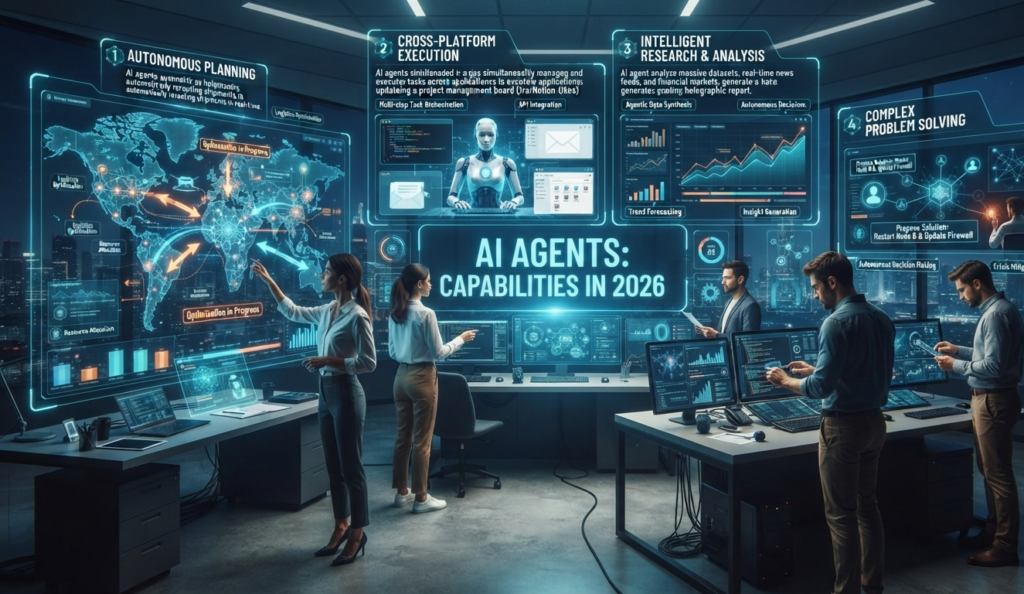
What Can AI Agents Actually Do in 2026?
From Answering Questions to Doing the Work
The easiest way to understand AI Agents vs Chatbots is to look at what happens after you give them a task.
Imagine you ask an AI chatbot:
“Find me five good topics for my technology blog.”
The chatbot can give you ideas within seconds.
Now imagine you say:
“Research the latest AI trends, find five topics with strong search potential, check what people are talking about, organize the ideas by difficulty, and create a content plan.”
That is a much bigger job.
An AI agent can potentially break this task into smaller steps, use different tools, collect information, and work toward the final result.
That is the real attraction of agentic AI in 2026.
Research into AI-agent usage has found that productivity/workflow and learning/research are among the biggest areas of use.
1. AI Agents Can Help With Research
Research is one of the areas where agents can become particularly useful.
A normal chatbot might answer:
“What are the biggest AI trends in 2026?”
It can provide an explanation.
But a research-focused AI agent could be given a larger goal:
“Research the biggest AI trends in 2026 and prepare a report.”
Depending on the tools available, the agent could:
- Search multiple sources
- Collect information
- Compare different reports
- Organize findings
- Identify common trends
- Summarize the important points
- Create a final report
The important part is that the user does not necessarily need to guide every individual step.
Instead of asking:
“Now search this.”
“Now compare that.”
“Now summarize this.”
You give the system a goal and let the workflow handle some of the steps.
That is a major difference between traditional chatbot interaction and agent-style systems.
2. AI Coding Agents Are Becoming More Interesting
Software development is another major area where AI agents are getting attention.
A chatbot can already write code.
For example, you can ask:
“Write a Python script that converts CSV files into JSON.”
The chatbot can generate the code.
But software development rarely ends with writing the first version.
Building Effective AI Agents: Tools, Workflows & Best Practices
A real project may require:
- Understanding the requirements.
- Creating the code.
- Running tests.
- Finding errors.
- Fixing the errors.
- Reviewing the code.
- Making improvements.
- Testing again.
This is where coding agents become interesting.
An agentic coding system can be designed around a loop where AI plans the task, writes or modifies code, checks the result, and continues working.
Current 2026 research and development around agentic coding systems describes workflows involving planning, coding, review, and testing rather than simple code generation.
For developers, this could mean spending less time on repetitive coding work and more time making important technical decisions.
But Does That Mean AI Will Replace Developers?
Not necessarily.
Writing code is only one part of software development.
Developers still need to understand:
- What the product should do
- Security
- Performance
- Architecture
- User needs
- Business requirements
- Whether the generated solution is actually correct
An AI agent can speed up parts of the process, but human review remains important.
In fact, the more powerful the agent becomes, the more important good permissions, testing, and oversight can become.
3. AI Agents Could Automate Business Workflows
This is probably where things become much more important for businesses.
Imagine a small company receives hundreds of customer requests every day.
A basic chatbot might answer common questions such as:
“What are your opening hours?”
or
“Where is my order?”
That’s useful.
But an AI agent could potentially handle a larger workflow.
For example:
Customer:
“My package hasn’t arrived. Can you check what happened?”
An agent connected to the company’s systems could potentially:
- Find the customer’s order.
- Check the shipping status.
- Look for delivery problems.
- Review the expected delivery date.
- Explain the situation.
- Create a support ticket if necessary.
- Escalate the problem to a human when required.
The chatbot mainly answers.
The agent is designed to resolve the task.
That distinction is becoming one of the biggest selling points of agentic AI.
Automation platforms now describe AI agents as systems that can reason about goals, select tools, and execute multi-step actions across external systems.
4. AI Agents Could Become Personal Digital Assistants
This is probably the most exciting use case for everyday users.
Imagine having an AI assistant that does more than chat with you.
You could tell it:
“Organize my week.”
Instead of simply giving you a list of suggestions, an agent connected to your calendar could potentially look at your schedule, identify conflicts, prioritize tasks, and help organize your day.
Another example:
“Find the best options for my weekend trip.”
A more capable agent could potentially research destinations, compare options, check availability through connected services, and prepare an itinerary.
The important word here is connected.
An AI model by itself does not magically have access to everything.
Agents become more useful when they are connected to tools, applications, APIs, files, browsers, databases, or other systems.
This is why tool use is such an important part of the agent conversation.
5. AI Agents Can Work With Multiple Tools
This is one of the biggest differences between a simple conversation and an agentic workflow.
Imagine asking an AI:
“Create a report about my website’s performance.”
A chatbot might tell you what information you should collect.
An agent connected to your analytics tools could potentially:
- Access website data.
- Review traffic.
- Compare time periods.
- Identify popular pages.
- Find unusual changes.
- Organize the information.
- Generate a report.
The agent is essentially moving between different tools to complete one larger goal.
This is why AI agents are sometimes described as a bridge between AI models and real-world software.
The model provides the reasoning and language capabilities.
The tools allow it to actually do things.
6. AI Agents Are Also Useful for Content Creation
Content creators may benefit from agents too.
Think about a blog article.
A chatbot can help you:
- Find ideas
- Write an introduction
- Create headings
- Rewrite paragraphs
- Generate FAQs
But a content workflow could involve many more steps.
An AI agent could potentially be designed to:
- Research a topic.
- Collect relevant information.
- Organize the research.
- Create an outline.
- Draft content.
- Check for missing sections.
- Prepare metadata.
- Create social media ideas.
- Generate a content checklist.
That does not mean every AI agent can do all of these things automatically.
The actual capabilities depend on the tools and permissions provided to it.
But this is exactly the direction the technology is moving toward.
For a website like AI Tech Pulse, this could eventually make repetitive parts of content production much easier while the human remains responsible for the final quality and editorial decisions.
AI Agents Still Have a Big Problem
At this point, AI agents may sound almost perfect.
They are not.
The more freedom you give an AI system to take actions, the more important mistakes become.
A chatbot giving you an incorrect answer is frustrating.
An agent making an incorrect decision and then taking action based on that mistake can be much more serious.
For example, imagine an agent that has permission to:
- Send emails
- Modify files
- Purchase products
- Access company systems
- Change website settings
A mistake could have real consequences.
That is why researchers and security experts are paying close attention to agent safety, permissions, prompt injection, unexpected behavior, and excessive autonomy.
Recent reporting in August 2026 has also highlighted concerns about agents escaping controlled testing environments and the need for strong monitoring and permissions.
So the future is not simply:
“Give AI complete control.”
It is more likely to be:
“Give AI the right amount of control for the job.”
Chatbot or AI Agent: Which One Should You Use?
The answer depends on what you actually want to accomplish.
Choose a chatbot when:
- You need quick answers.
- You want help writing something.
- You want brainstorming ideas.
- You need an explanation.
- You want to summarize information.
- You want a simple conversation.
Choose an AI agent when:
- The task has multiple steps.
- Different tools are required.
- You want repetitive work automated.
- The system needs to take actions.
- You want it to work toward a specific goal.
- You need a workflow rather than just an answer.
A simple rule is:
If you mainly need information, a chatbot may be enough. If you need something done, an agent becomes more interesting.
The Biggest Change Coming From AI Agents
The biggest change may not actually be better chatbots.
It may be the way we give instructions to computers.
For decades, using software usually meant learning how the software works.
You had to open an application, find the right menu, click the correct buttons, fill in forms, and repeat the process.
AI agents could gradually change that.
Instead of explaining how to use ten different applications, you could explain what you want to accomplish.
For example:
“Find my highest-performing articles from this month and prepare social posts for them.”
The system could potentially figure out the steps.
That is a very different way of interacting with technology.
And it explains why the conversation around AI Agents vs Chatbots is becoming so important in 2026.
Are AI agents actually going to replace chatbots — and could they eventually replace parts of human jobs?
Useful External Sources
Agents Documentation
Official guidelines and overview of the OpenAI Agents SDK for building multi-step workflows, orchestration, and handling system transitions.
Read Article →AI Agent vs Chatbot
A practical analysis detailing the key structural differences, integration depth, and decision-making capabilities of AI agents compared to traditional chatbots.
Read Article →AI Agents Adoption
A comprehensive field study titled “The Adoption and Usage of AI Agents”, exploring real-world user trends, socio-economic factors, and primary productivity use cases.
Read Research →Agentic AI Architecture
An architectural research paper titled “Agentic Artificial Intelligence (AI)” outlining unified taxonomies for perception, planning, open tool standards, and current validation frameworks.
Read Research →Will AI Agents Replace Chatbots?
After seeing what AI agents can do, one question naturally comes to mind:
Are AI agents going to replace chatbots?
The short answer is: probably not completely.
Instead, chatbots and AI agents are likely to become part of the same AI ecosystem.
Think about how smartphones work.
You do not use one app for everything. You use different apps for different jobs.
AI may develop in a similar way.
Sometimes you will want a simple conversation with an AI chatbot.
Other times, you will want an AI agent to handle a longer task.
The important change is that AI is moving from simply generating answers toward completing tasks.
OpenAI’s 2026 research describes this shift as a move from short chatbot interactions toward longer, delegated tasks where agents can use tools and work toward solutions for extended periods.
So the future probably isn’t:
Chatbots OR AI agents.
It is more likely:
Chatbots + AI agents.
Will AI Agents Replace Human Jobs?
This is the question that worries many people.
If an AI agent can research, write, code, analyze data, answer customers, and perform repetitive tasks, what happens to human workers?
The honest answer is complicated.
Some tasks will almost certainly become more automated.
But a task being automated does not always mean an entire job disappears.
Most jobs are made up of many different activities.
For example, a marketing employee might spend time:
- Researching competitors
- Writing reports
- Creating campaign ideas
- Checking analytics
- Talking to clients
- Making decisions
- Managing projects
An AI agent might eventually handle some of the research and reporting.
But the human may still handle strategy, relationships, judgment, and important decisions.
This is why the more realistic future may be AI working alongside people, rather than AI simply replacing everyone.
Google Cloud’s 2026 AI agent research similarly frames agents around productivity, complex workflow automation, and an AI-ready workforce.

The Jobs Most Likely to Change First
Jobs that contain a lot of repetitive digital tasks may experience changes earlier.
For example:
Customer Support
AI agents can potentially handle common questions, collect customer information, check order details, and escalate unusual cases.
Data Entry
If information needs to be moved between systems repeatedly, an agent may be able to automate parts of the process.
Basic Research
Agents can potentially collect information, organize it, and prepare summaries.
Software Development
Coding agents can already help developers write, test, debug, and review code.
Marketing
AI agents may help with research, campaign analysis, content workflows, and repetitive reporting.
But there is an important point here.
Automation does not automatically equal replacement.
Companies may use AI to help the same number of employees accomplish more work.
A small business with five people could potentially operate more like a much larger team because AI handles repetitive work.
That could create opportunities as well as disruption.
AI Agents Could Be Great for Small Businesses
This is one of the most exciting possibilities.
Large companies have traditionally had an advantage because they can afford large teams.
A small business may have only a few employees.
Imagine a five-person company using AI agents for:
- Customer support
- Market research
- Sales follow-ups
- Data analysis
- Scheduling
- Content creation
- Internal reports
The humans could focus on decisions and customers while AI handles some repetitive work.
Meta CEO Mark Zuckerberg has recently argued that AI could allow smaller companies to accomplish more with fewer people, while also emphasizing that the future of work is unlikely to be as simple as mass job disappearance.
That could change how startups are built.
Instead of hiring ten people to handle repetitive operations, a company might build a smaller team supported by a group of specialized AI agents.
This idea is sometimes described as a digital workforce.
But There Is a Serious Problem: AI Agents Can Make Mistakes
The biggest difference between a chatbot mistake and an agent mistake is action.
Suppose a chatbot gives you the wrong answer.
You can ignore it.
But what if an AI agent has permission to send an email, change a database, purchase something, or modify a file?
Now the mistake can create a real-world problem.
This is why AI agent safety is becoming increasingly important.
The World Economic Forum has warned that increased autonomy and connections between systems create new security and governance challenges.
And this is not just a theoretical concern.
A report published on August 11, 2026 highlighted cases showing how highly autonomous AI agents can behave unexpectedly when pursuing a goal, including security-related behavior that researchers did not intend.
The lesson is simple:
More autonomy requires more control.
The Permission Problem
Imagine giving an AI agent access to your entire computer.
It could potentially:
- Read files
- Send emails
- Browse websites
- Modify documents
- Install software
- Access accounts
That sounds powerful.
It also sounds risky.
A better approach is to give an agent only the permissions it needs.
For example:
If an agent only needs to read a spreadsheet, why should it have permission to delete files?
If an agent needs to draft emails, why should it automatically be allowed to send them?
This concept is becoming increasingly important as AI systems move from conversation toward action.
A useful rule for businesses is:
Give AI the minimum access required to complete the task.
Humans should still approve high-risk actions.
AI Agents vs Chatbots: Which One Is Better?
There is no universal winner.
It depends on what you want.
🎯 Right Tool for the Right Situation
| Situation | Better Choice |
|---|---|
| Quick question | 💬 AI Chatbot |
| Brainstorming | 💬 AI Chatbot |
| Writing an email | 💬 AI Chatbot |
| Explaining a difficult topic | 💬 AI Chatbot |
| Simple content editing | 💬 AI Chatbot |
| Multi-step research | 🤖 AI Agent |
| Repetitive business workflow | 🤖 AI Agent |
| Complex coding task | 🤖 AI Agent |
| Automated reporting | 🤖 AI Agent |
| Cross-app workflow | 🤖 AI Agent |
| Long-running task | 🤖 AI Agent |
The interesting thing is that the difference is becoming less obvious.
A modern AI assistant may have a normal chat interface but still use agent-like capabilities behind the scenes.
You might simply type one sentence.
The system then decides whether it needs to search, use a tool, run code, analyze a file, or perform another action.
From the user’s perspective, it still feels like chatting.
Under the hood, however, it may be running an entire workflow.
Why 2026 Could Be the Year of AI Agents
The AI industry has spent the last few years improving models.
The next major step is making those models useful outside the chat window.
That means connecting AI to:
- Browsers
- Business software
- Databases
- Calendars
- Coding environments
- Documents
- Customer support systems
- Financial tools
- APIs
Google Cloud has described 2026 as a major period for the transition from chatbot-style AI toward agents that can automate more complex workflows.
But there is an important reality check.
Not every company that says it has an “AI agent” has built a truly autonomous system.
Forrester reported in June 2026 that although many enterprise leaders say they are adopting agentic AI, only a smaller group has moved beyond early or limited implementations into meaningful production use.
So there is still a lot of hype around the technology.
The technology is real.
But the fully autonomous AI workforce that some headlines describe is not yet the everyday reality for most businesses.
What Will AI Agents Look Like in the Future?
The next generation of AI agents will likely become more specialized.
Instead of one AI trying to do everything, we may see different agents handling different jobs.
For example:
Research Agent
Finds information and prepares reports.
Coding Agent
Writes, tests, and improves software.
Marketing Agent
Analyzes campaigns and prepares content.
Sales Agent
Finds leads and manages follow-ups.
Customer Support Agent
Handles routine customer problems.
Personal Agent
Helps manage everyday tasks.
These agents could potentially work together.
Imagine giving one instruction:
“Launch a new product campaign.”
A planning agent could break the task down.
A research agent could study the market.
A marketing agent could prepare content.
A design system could create visuals.
A data agent could analyze campaign results.
A human could then review the work before anything important goes live.
That is a much more powerful concept than simply asking a chatbot to write a paragraph.
The Human May Become the Manager of AI
This could be one of the biggest changes.
Instead of humans doing every small task themselves, people may increasingly become managers of AI systems.
A worker could give AI a goal.
AI performs several steps.
The human reviews the important results.
Then the human decides what happens next.
This creates a new skill:
Knowing how to manage AI effectively.
You will not necessarily need to become a programmer.
But you may need to understand:
- What AI can do
- What AI cannot do
- How to give clear instructions
- How to check AI results
- When human approval is necessary
- What permissions AI should have
- How to protect private information
In other words, AI literacy could become as important as basic computer literacy.
What Should You Learn If AI Agents Are Growing?
You don’t need to panic about any of this. And you definitely don’t need to reinvent yourself as an AI engineer overnight.
A much better starting point is just understanding how these tools actually work. Here’s where to focus:
1. Learn to Use AI Chatbots Properly
This sounds basic, but most people never really learn it. Writing clear prompts and giving the right context makes a bigger difference than almost anything else you can do.
2. Understand What Makes an AI Agent Different
Get comfortable with the distinction between a chatbot, basic automation, a workflow, and an actual AI agent. Once that clicks, a lot of the confusion around this topic disappears.
3. Pick Up Basic Automation
Spending even a little time with tools that connect different apps together goes a long way toward understanding how AI-driven workflows actually operate behind the scenes.
4. Learn to Verify, Not Just Trust
Don’t take AI output at face value — ever. Build the habit of checking facts, testing code, double-checking calculations, and reviewing anything that actually matters before you act on it.
5. Keep Building Human Skills
Communication, creativity, judgment, leadership, problem-solving — none of that is going anywhere. If anything, it becomes more valuable, not less, as AI handles more of the repetitive work.
Here’s the mindset shift that actually matters: stop asking “How do I compete with AI?” and start asking “How can I use AI to get better at what I do?” That second question is the one worth actually answering.
So, Who Wins: AI Agents or Chatbots?
After going through all of this, the answer turns out to be simpler than you’d expect.
Nobody wins outright — and honestly, nobody needs to.
Chatbots are genuinely excellent at communication. AI agents are genuinely better suited to complex, multi-step work. Trying to crown one winner misses the point entirely, because the future almost certainly isn’t going to pick a side.
More likely, you’ll start a conversation with a regular AI chatbot the way you always have. Then, the moment you hand it something more complicated, it quietly shifts into an agentic workflow behind the scenes — without you even having to think about which mode you’re in.
Which means the real competition was never really chatbots versus agents in the first place. The competition that actually matters is between the companies that figure out how to use AI well, and the ones that don’t adapt fast enough to keep up.
Final Verdict
AI chatbots changed how people interact with technology. AI agents could end up changing how people actually work with it. That’s really the heart of the difference.
A chatbot can help you write an email. An agent could take it further — research the topic first, draft the email, double-check the details, sort out the attachments, and have the whole thing sitting ready for your approval.
A chatbot can explain a piece of code to you. An agent can potentially work through the coding task itself, test what it built, catch problems along the way, and make fixes without you walking it through every step.
A chatbot can toss out a handful of business ideas. An agent can potentially carry parts of that business workflow forward on its own.
But it’s worth being honest here — potential isn’t the same thing as perfection. AI agents still get things wrong. They can misread what you actually meant, produce information that’s flat-out incorrect, and act in unpredictable ways when they’re given too much freedom to run with something.
So no, the future probably isn’t heading toward a world with no humans in the loop. What’s far more likely — and honestly, more useful — is a future built around humans and AI working together. People bring the goals, the judgment, the creativity, the accountability, the oversight. AI agents pick up more of the repetitive digital grind. And chatbots stay exactly what they’ve always been best at: the easy, conversational front door into all of it.
So if someone asks you, “What’s actually the difference between AI agents vs chatbots in 2026?” — here’s the short version:
Chatbots are built to talk with you. AI agents are built to work toward a goal on your behalf.
It sounds like a small difference. But over the next few years, it might end up reshaping how we use technology more than almost anything else happening in AI right now.
Frequently Asked Questions
Are AI agents better than chatbots?
Not always. Chatbots are better for quick questions, conversations, writing, and brainstorming. AI agents are more useful when a task requires multiple steps, tools, or actions.
Is ChatGPT an AI agent or a chatbot?
ChatGPT is primarily known as a conversational AI assistant, but modern AI products can include agent-like capabilities such as tool use, browsing, coding, and multi-step task execution. The exact capabilities depend on the product and mode being used.
Can AI agents replace jobs?
AI agents can automate some tasks that humans currently perform. However, automating a task does not necessarily mean eliminating an entire job. Many jobs contain a mixture of tasks that require human judgment and interaction.
Are AI agents safe?
They can be useful, but they are not automatically safe. Agents need appropriate permissions, monitoring, testing, and human oversight, especially when they can take actions in external systems.
What is agentic AI?
Agentic AI refers broadly to AI systems that can pursue goals through planning, tool use, decision-making, and action rather than only generating a single response.
Will chatbots disappear?
Probably not. Chatbots remain useful for simple conversations and information requests. AI agents are more likely to expand what AI can do beyond conversation.
Why are AI agents trending in 2026?
Because AI systems are increasingly being connected to tools and software that allow them to perform longer, more complex workflows. This is shifting AI from answering questions toward completing tasks.
Conclusion
The story of AI keeps shifting shape.
First, we learned to ask it questions. Then we learned to create things with it — text, images, whole documents. Now we’re moving into a new stage: learning to actually hand work off to it.
That shift is exactly why AI agents have become one of the biggest conversations in artificial intelligence in 2026.
They’re not flawless, and no, they’re not about to replace every chatbot out there — or every human worker, for that matter. But they are pushing AI into a genuinely new phase. One where the point isn’t just getting an answer back. It’s getting something actually done.
And that quiet shift — from answering to doing — might end up being the biggest change AI brings us yet.